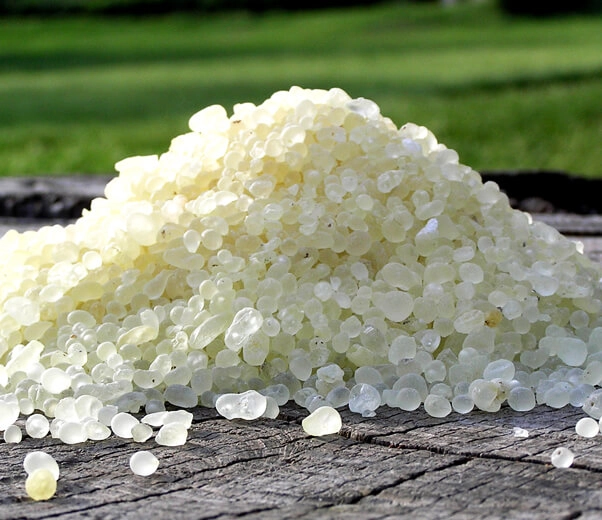
Pure Greek mastic pearls
12.0 kg.
The precious resin of the island of Chios
✔ 100% natural products used by humans for over 4000 years - selected origin - GMO-free
Resins and balms
High-quality grain incense from the most ancient ports of the Middle East.
Frankincense is by far the most well-known aromatic resin; it consists of the latex that oozes from the bark of various species of Boswellia (Burseracee), dried by exposure to air and sun.
Its ritual and purifying uses are lost in the mists of time.
The high quality of our incense is due to the rigorous selection of the original plantations in East Africa and the Arabian Peninsula, as well as the careful selection of the packaged grains; Those that are too fine and/or dusty are discarded as they constitute the lowest-quality fraction of the harvest, as the resin is much more oxidized and altered.
- Code: 00320
- Note type: pine tree, resinous, fresh
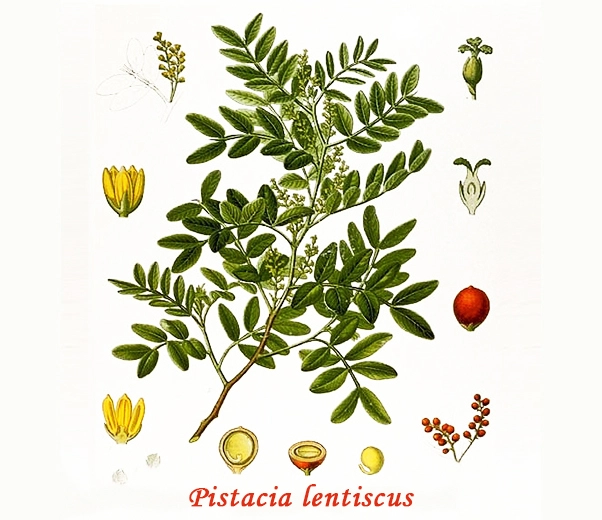
- INCI: Pistacia lentiscus
- CAS: 61789-92-2
- Family: Anacardiaceae
- Type: natural resin (RN)
- Origin: Greece (Kios)
Description
The precious and sophisticated resin of the island of Chios.
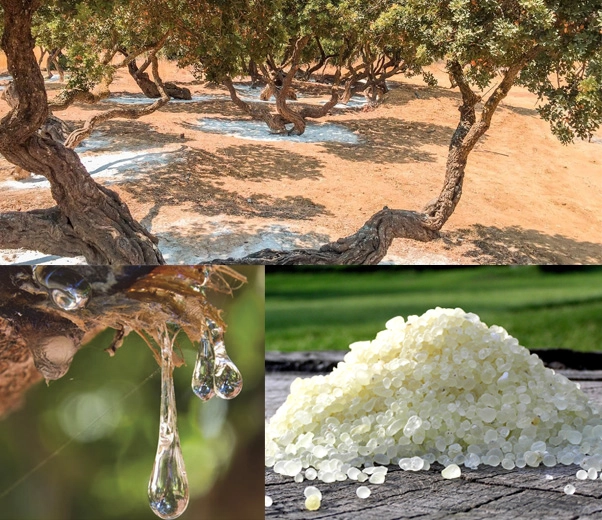
Just a stone's throw from the Turkish coast, in the blue of the northern Aegean Sea, lies the homeland of one of the most sought-after and prized aromatic raw materials since ancient times: the splendid Greek island of Chios, long renowned for being the principal (if not the only) place for harvesting the famous Greek Mastic (also known as Chios Mastic). This is a pure white, opalescent resin, produced by cutting into the stem and branches of a plant endemic and abundant there: the Mastic (Pistacia lentiscus), an evergreen shrub of the Anacardiaceae family, of which a prized variety grows on the island. The incisions (made mostly in the summer) slowly exude a viscous latex that hardens upon exposure to the elements. The solidified tears, with their typical yellowish color, are then collected and washed to remove any impurities. This gives the mastic its characteristic snow-white appearance. Traditionally, it is stored in wooden tubs.
Just a stone's throw from the Turkish coast, in the blue of the northern Aegean Sea, lies the homeland of one of the most sought-after and prized aromatic raw materials since ancient times: the splendid Greek island of Chios, long renowned for being the principal (if not the only) place for harvesting the famous Greek Mastic (also known as Chios Mastic). This is a pure white, opalescent resin, produced by cutting into the stem and branches of a plant endemic and abundant there: the Mastic (Pistacia lentiscus), an evergreen shrub of the Anacardiaceae family, of which a prized variety grows on the island. The incisions (made mostly in the summer) slowly exude a viscous latex that hardens upon exposure to the elements. The solidified tears, with their typical yellowish color, are then collected and washed to remove any impurities. This gives the mastic its characteristic snow-white appearance. Traditionally, it is stored in wooden tubs.
Uses
Greek mastic is still used today both as a prized raw material for high-end perfumery (which is the use that has made it a highly sought-after commodity for centuries) and in the production of chewing gum.
Botany
From the incisions made on the Mastic tree, an evergreen shrub native to the Mediterranean scrub, a viscous latex slowly oozes, which hardens upon exposure to the elements: this is the well-known natural oleoresin known as mastic, a highly valuable commodity found in every bazaar of the ancient world.
Also known as the "mastic tree", the Mastic tree exudes a strong, resinous odor. Native to the Mediterranean basin (particularly the northeastern Aegean islands), it is also found in Portugal and the Canary Islands. Growing up to three meters tall, it has leathery leaves, small reddish flowers, and a pink heartwood.
Also known as the "mastic tree", the Mastic tree exudes a strong, resinous odor. Native to the Mediterranean basin (particularly the northeastern Aegean islands), it is also found in Portugal and the Canary Islands. Growing up to three meters tall, it has leathery leaves, small reddish flowers, and a pink heartwood.
History
A highly valuable commodity, Greek mastic could be purchased in every bazaar in the ancient world. Besides perfumery, its most well-known and appreciated use was burning it (similarly to incense, usually alongside it) to benefit from the balsamic and sanitizing properties of its fumigations. However, due to its beneficial effects on the oral cavity (a natural antiseptic and breath purifier), it was also used as a chewing gum.
 Arabian frankincense
 Greek mastic
 Japanese incense
 Thuribles and charcoals discs
 Tibetan rituals
 Aromatic healing papers
 Pure Greek mastic pearls