
Thuja
Pure and natural essential oil
Bulk packaging > Essential oils
A wide range of pure and natural absolute oils and essential oils of guaranteed quality, constantly available for any industrial use.
- Code: T1552
- INCI: Thuya occidentalis
- CAS: 8007-20-3
- EINECS: 290-370-1
- Family: Cupressaceae
- Type: pure essential oil (EO)
- Chemotype: α‑thujone (minimum 55%)
- Food flavoring: No
- Extraction method: steam distillation
- Purity: 100%
- Origin: Canada
Extraction
Thuja essential oil is obtained by steam distillation of fresh leaves and twigs as well as the bark and appears as a vaguely yellowish liquid with a dry, woody-balsamic odor with a camphoraceous undertone.
Property
Thuja essential oil (a rubefacient and effective insect repellent) has anti-viral properties : for this reason, a medicinal ointment containing this essence is still used to treat warts, psoriasis, and other skin conditions. Since it is toxic, it should never be used as is for aromatherapy purposes, either internally or externally.
It harmonizes well with the essential oils of camphor, cypress, juniper, cedarwood, mountain pine, ravensara, and tea tree.
It harmonizes well with the essential oils of camphor, cypress, juniper, cedarwood, mountain pine, ravensara, and tea tree.
Uses
Thuja essential oil is typically used in pharmaceuticals, especially in the formulation of disinfectants. It is also occasionally used as a fragrance component in various personal hygiene products.
The relevant technical and safety documentation for the product is available upon request.
The relevant technical and safety documentation for the product is available upon request.
Botany
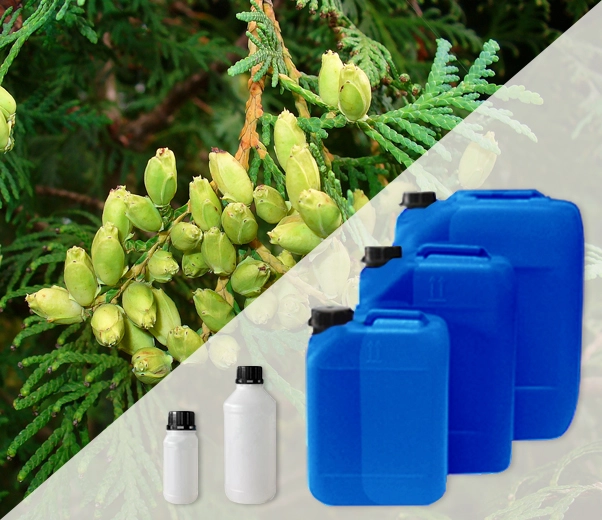
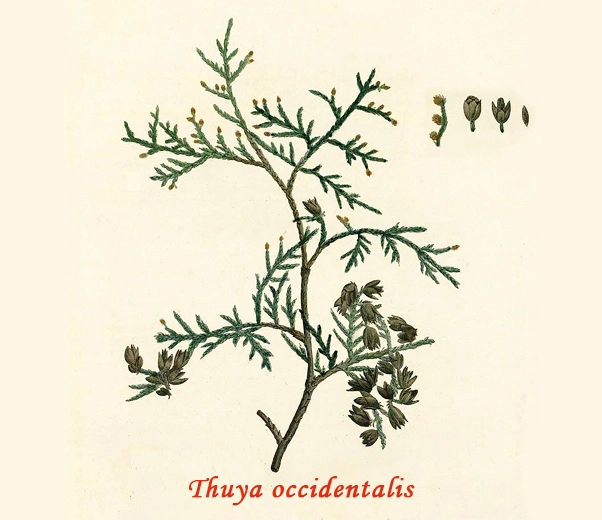
Native to the northeastern regions of North America, Thuja is also known as the "white cedar" or "tree of life". It is a graceful conifer that reaches twenty meters in height, with a characteristic pyramidal crown. It has small, imbricated, light green leaves arranged in fans, a tapered trunk, orange-brown bark, and aromatic wood.
 Camphor
 Cedar wood
 Cypress
 Dwarf mountain pine
 Juniper berries
 Ravensara
 Tea tree
 Home fragrances
 Aroma chemicals
 Measuring instruments
 Containers
 Fine perfumery fragrances
 Thuja
Thuja