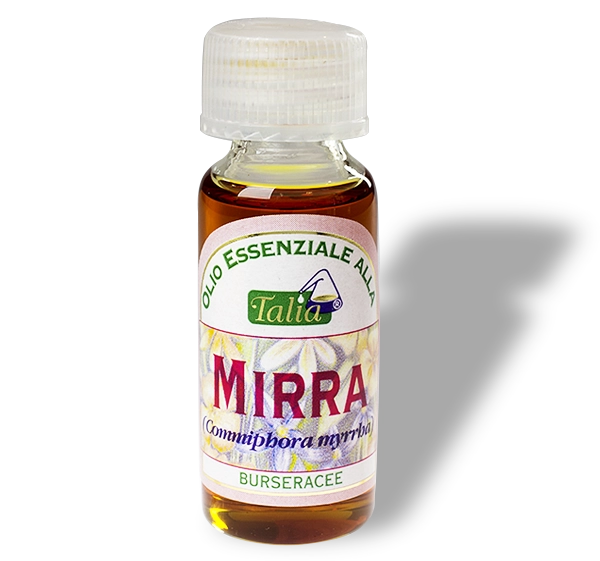
Myrrh
Essence de Corne d'Afrique
Confezione: 13.5 ml bottle.
-
9,70 €
✔ Fragrances selected since 1993 · IFRA compliant · Long-lasting scent performance · Fast shipping within 24/48h
Fine perfumery fragrances
Our line of fine perfumery fragrances is the result of painstaking research, selection, and composition since 1988. The ongoing selection of raw materials and constant laboratory testing have always allowed us to enrich the olfactory characteristics of our compositions.
- Code: 11131
- Note type: warm, spicy, resinous
- Type: reconstituted essence (ER)
- Origin: Italy
Related accessories

Description
A thematic fragrance from fine perfumery containing natural Myrrh absolute oil (a product we also have in stock).
Our exclusive 13.5 ml (0.46 fl. oz.) bottle made of special transparent neutral glass enhances the chromatic properties of the various oils: each is visible in its natural color, as unique as the scent it emanates.
Each bottle is equipped with a special transparent heat-shrink polymer seal to guarantee (in compliance with regulations) its tamper-proof integrity.
Our exclusive 13.5 ml (0.46 fl. oz.) bottle made of special transparent neutral glass enhances the chromatic properties of the various oils: each is visible in its natural color, as unique as the scent it emanates.
Each bottle is equipped with a special transparent heat-shrink polymer seal to guarantee (in compliance with regulations) its tamper-proof integrity.
Extraction
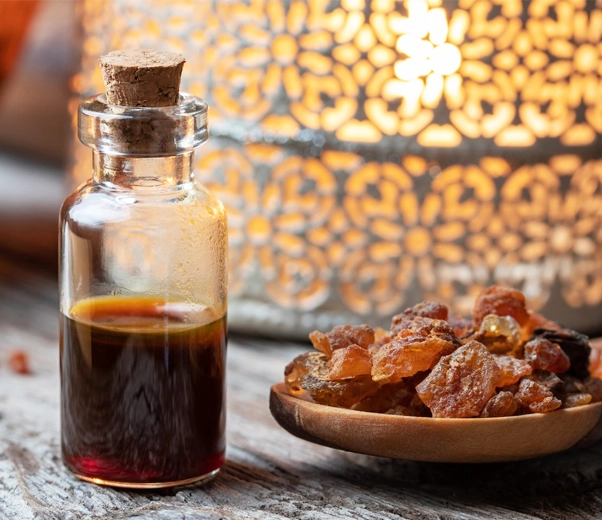
Myrrh absolute (the basis of our composition) is obtained through solvent extraction from the resin. It appears as a dark red liquid with a characteristic, warm, spicy-balsamic scent with a medicinal undertone, and is very persistent. It blends well with benzoin and oakmoss absolutes, spicy oils, and the essential oils of cypress, geranium, juniper, frankincense, lavender, mandarin, mint, frankincense, opoponax, patchouli, sandalwood, and red thyme.
Properties
The natural absolute oil of myrrh (present in our composition), completely non-toxic and non-irritating, has antiseptic, balsamic, stimulating, and tonic properties; it is an excellent remedy for chapped skin, itching, and the development of wrinkles. The resin has been used in medicine since ancient times (its use is cited in sources dating back over 3,700 years). In addition to being burned to obtain aromatic fumigations, it was used by the ancient Egyptians in the embalming process as well as in the preparation of cosmetics and perfumes.
Uses
Myrrh essence, like natural absolute, is used as a fixative and as a fragrance component in perfumery and cosmetics.
Botany
Native to East Africa and the Arabian Peninsula, myrrh is a shrub that grows up to ten meters tall, with sturdy, gnarled branches, aromatic leaves, and small white flowers. The trunk exudes a natural oleoresin which, when solidified, takes on the appearance of reddish-brown tears known as "myrrh gum". To increase yield, harvesters make incisions in the tree's bark.
 African geranium
 Benzoin
 Bitter orange
 Ethiopian olibanum
 Field mint
 Flowering Lavender
 Frankincense with Myrrh
 Frankincense with Myrrh
 Green mandarin
 Incense
 Morning Star Myrrh
 Myrrh
Myrrh Oakmoss
 Opoponax
 Patchouli
 Patchouli
 Pure myrrh tears
 Sandalwood
 Sweet orange
 Essential oils
 Home fragrances
 Essence diffusers
 Myrrh
Myrrh