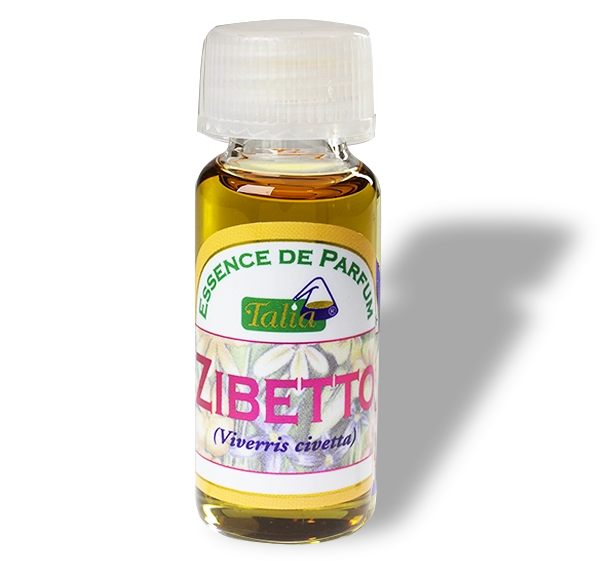

Civet
Sensual essence
Confezione: 13.5 ml bottle.
-
12,30 €
✔ Fragrances selected since 1993 · IFRA compliant · Long-lasting scent performance · Fast shipping within 24/48h
Fine perfumery fragrances
Our line of fine perfumery fragrances is the result of painstaking research, selection, and composition since 1988. The ongoing selection of raw materials and constant laboratory testing have always allowed us to enrich the olfactory characteristics of our compositions.
- Code: 11170
- Note type: warm, musky, animal
- Type: reconstituted essence (ER)
- Origin: Italy
Related accessories

Description
Our Civet essence is a thematic fragrance of the highest perfumery with a powerful "animal" note inspired by - but completely free from - the natural secretion obtained from the perianal glands of the Civet, the small African carnivore (" Viverris civetta") whose name derives from the Arabic "Zabad" (Musk), a name also attributed to the secretion itself. Similar to the product of natural origin, our fragrance is characterized by an enchanting warm and sensual note which, at first impact, recalls Musk.
Our exclusive 13.5 ml. (0.46 fl. oz.) bottle in special transparent neutral glass enhances the chromatic properties of the various oils: each is visible in its natural color, completely unique like the scent it releases. Each bottle is equipped with a special heat-shrinkable transparent polymer seal to guarantee (in accordance with the regulations) its tamper-evident integrity.
Our exclusive 13.5 ml. (0.46 fl. oz.) bottle in special transparent neutral glass enhances the chromatic properties of the various oils: each is visible in its natural color, completely unique like the scent it releases. Each bottle is equipped with a special heat-shrinkable transparent polymer seal to guarantee (in accordance with the regulations) its tamper-evident integrity.
Extraction
La nostra fragranza tematica si ispira all'odore della secrezione delle ghiandole perianali di un piccolo carnivoro africano (Viverris civetta), una delle materie prime aromatiche naturali d'origine animale più ambite dai profumieri di tutto il mondo, detta Zibetto, dall'arabo "Zabad" (Muschio), nome attribuito anche all'animale stesso. Pochi esemplari di questo mammifero sopravvivono liberi in natura, per lo più in Etiopia ed in Egitto: la maggior parte è mantenuta invece in cattività allo scopo di ottenerne la pregiata materia prima odorosa.
L'animale produce settimanalmente circa tre/quattro grammi di secrezione la quale viene generalmente asportata con semplici cucchiai. Da notare che pure allo stato naturale, lo Zibetto necessita di liberarsi periodicamente della propria secrezione ghiandolare: per questo si strofina contro pietre e tronchi d'albero.
Lo Zibetto naturale (detto pure Civetone) è caratterizzato da un potente odore animale, acuto, molto caldo, simile a quello del muschio. Appena raccolto si presenta come un liquido bianco schiumoso, untuoso ed appicicaticcio che tende a scurirsi man mano che rapprende, fin quando assume il caratteristico aspetto di una pasta color ocra-bruno.
La sua peculiarità olfattiva è dovuta al contenuto in Civetone (o "Zibettone"): un ciclo-chetone che rappresenta uno dei più antichi ingredienti della profumeria a cagione - tra l'altro - delle sue spiccate proprietà fissanti; questo tipo di molecole oggi viene riprodotto anche sinteticamente.
Lo Zibetto, celebre - ed ormai sempre più rara - materia prima naturale, come pure la nostra fragranza tematica d'alta profumeria, si armonizza eccellentemente in miscela con un gran numero di essenze, ma in particolare con: Agarwood, Ambra grigia, Cisto, Costo, Iris, Muschio bianco, Musk oil, Nardo indiano, Patchouli, Vaniglia, Vetiver e Zenzero.
L'animale produce settimanalmente circa tre/quattro grammi di secrezione la quale viene generalmente asportata con semplici cucchiai. Da notare che pure allo stato naturale, lo Zibetto necessita di liberarsi periodicamente della propria secrezione ghiandolare: per questo si strofina contro pietre e tronchi d'albero.
Lo Zibetto naturale (detto pure Civetone) è caratterizzato da un potente odore animale, acuto, molto caldo, simile a quello del muschio. Appena raccolto si presenta come un liquido bianco schiumoso, untuoso ed appicicaticcio che tende a scurirsi man mano che rapprende, fin quando assume il caratteristico aspetto di una pasta color ocra-bruno.
La sua peculiarità olfattiva è dovuta al contenuto in Civetone (o "Zibettone"): un ciclo-chetone che rappresenta uno dei più antichi ingredienti della profumeria a cagione - tra l'altro - delle sue spiccate proprietà fissanti; questo tipo di molecole oggi viene riprodotto anche sinteticamente.
Lo Zibetto, celebre - ed ormai sempre più rara - materia prima naturale, come pure la nostra fragranza tematica d'alta profumeria, si armonizza eccellentemente in miscela con un gran numero di essenze, ma in particolare con: Agarwood, Ambra grigia, Cisto, Costo, Iris, Muschio bianco, Musk oil, Nardo indiano, Patchouli, Vaniglia, Vetiver e Zenzero.
Properties
Pochi prodotti possono poi vantare proprietà aroma-terapeutiche tanto antiche, visto che da quasi tremila anni allo Zibetto vengono attribuite virtù rinvigorenti ed afrodisiache (a questo scopo se ne preparava pure una pomata); anche impregnare un mobile di questa secrezione odorosa si diceva apportasse benefici (non solo olfattivi) all'intero locale.
Tra il Medioevo ed il Rinascimento l'uso dello Zibetto si diffuse largamente in Europa.
Ancor oggi, tanto nella penisola Arabica quanto nell'Africa orientale, lo Zibetto viene impiegato nel trattamento di alcuni disturbi ormonali nonché per contrastare la caduta dei capelli.
Tra il Medioevo ed il Rinascimento l'uso dello Zibetto si diffuse largamente in Europa.
Ancor oggi, tanto nella penisola Arabica quanto nell'Africa orientale, lo Zibetto viene impiegato nel trattamento di alcuni disturbi ormonali nonché per contrastare la caduta dei capelli.
Uses
Our thematic essence (as well as natural Civet) is used in perfumery as a fragrance component in the formulation of enveloping and voluptuous notes, as well as a precious fixative in aromatic compositions of various natures.
History
Truly rare and precious, the natural civet that inspires our composition has never been an easy product to enjoy: only when crafted by experts can one truly enjoy the unique emotions it evokes. Besides its better-known use in perfumery (widespread as a fragrance ingredient, especially in the 19th century), civet has also been used as a medicinal remedy since ancient times thanks to its antispasmodic and anti-inflammatory properties (it soothes skin affected by dermatitis). It is known that around 1000 BC, it was already common to collect this precious animal secretion for commercial purposes, with records of its importation from the Horn of Africa by King Solomon.
 Agarwood
 Costus
 Ginger
 Grey Amber
 Indian Spikenard
 Iris
Iris Musk oil
 Oriental Sweet amber
 Oudh balsamique
 Patchouli
 Vanilla
 Vetiver Haiti
 White Musk
 Essential oils
 Home fragrances
 Essence diffusers
 Civet
Civet Cardamom
 Incense
 Cinnamon bark
 Caraway
 Roman chamomile
 Valerian
 Common sage
 Coriander