Galangal
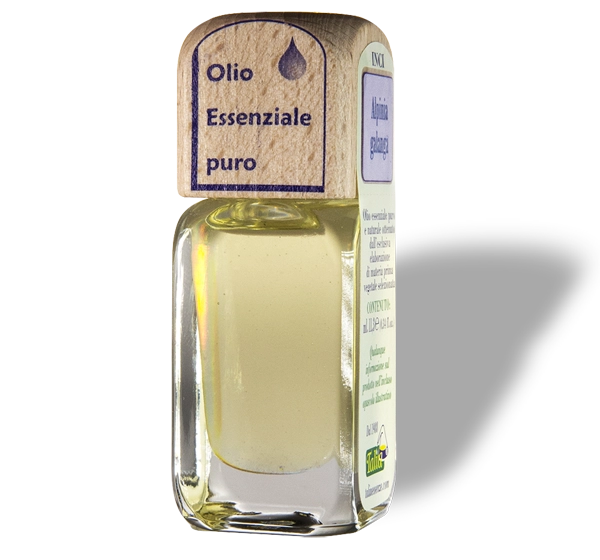
Pure essential oil of conventional origin
Confezione: 11.3 ml bottle.
-
9,80 €
✔ 100% pure and natural · Since 1993, selected GMO-free essential oils · Certified quality · Shipping within 24/48h
Essential oils
Made exclusively from pure natural distillates of excellent quality, totally free from stabilizers and/or fixatives of any kind, our essential oils represent the best that can be found by those who, without any “ ifs ” or “ buts ”, demand – in the literal sense of the term – the 100% quintessence of nature .
- Code: 21597
- INCI: Alpinia galanga
- CAS: 8024-40-6
- Family: Zingiberaceae
- Type: pure essential oil (EO)
- Variety: conventional
- Food flavoring: yes (according to EC Regulation 1334/2008)
- Extraction method: steam distillation
- Purity: 100%
- Origin: Indonesia
Related accessories

Description
100% pure and concentrated essential oil of natural origin in an 11.3 ml (0.34 fl. oz.) glass bottle ; this product is completely free from: stabilizers, fixatives, pesticides, GMOs and gamma irradiation treatments (even of semi-finished products) and has been packaged and sealed as it came, i.e., without having undergone any transformation and/or alteration of any kind and in the most diligent observance of all laboratory precautions. In accordance with EC Regulation 1334/2008 of the European Parliament and of the Council of the European Union, provided they are highly pure, many essential oils (including Galanga) are declared "food flavourings" and can therefore be taken as supplements.
As per the declaration of conformity published in the brochure, this essential oil was obtained exclusively from the processing of natural plant raw materials. The
information leaflet included with the packaging contains all the information relating to the natural preparation, including the analytical bulletin, the declaration of conformity, the botanical description, the possibility of use as a " food flavoring," etc.
Attention
Absolutely avoid the " do-it-yourself" internal use of essential oils,as this can be highly dangerous. It is advisable to always proceed with a medical prescription issued exclusively by a competent and qualified professional.As per the declaration of conformity published in the brochure, this essential oil was obtained exclusively from the processing of natural plant raw materials. The
information leaflet included with the packaging contains all the information relating to the natural preparation, including the analytical bulletin, the declaration of conformity, the botanical description, the possibility of use as a " food flavoring," etc.
Extraction
Galanga essential oil is obtained by steam distillation of the rhizomes and appears as a straw-yellow liquid that solidifies below 16°C, with a fresh camphoraceous-spicy scent with a medicinal-balsamic undertone.
Affinity
Galangal essential oil harmonizes well with Myrrh and Oakmoss absolutes as well as with the essential oils of: Moroccan Chamomile, Cinnamon, Clove, Coriander, Copaiba, Larch, Lavender, Mastic, Myrtle, Patchouli, Black Pepper, Mountain Pine, Rosemary, Opoponax and citrus oils in general.
Properties
Galanga essential oil has antiseptic, balsamic, bactericidal, and stimulating properties.
Diluted in vegetable oil, it produces a medicinal ointment that is effective against various respiratory problems and alleviates the effects of fatigue.
Popular herbal tradition even attributes its properties to promoting circulation, thus promoting muscle relaxation; for this purpose, in aromatherapy, a few drops are suggested in a hot bath. Diffused in the air, it promotes drowsiness.
Diluted in vegetable oil, it produces a medicinal ointment that is effective against various respiratory problems and alleviates the effects of fatigue.
Popular herbal tradition even attributes its properties to promoting circulation, thus promoting muscle relaxation; for this purpose, in aromatherapy, a few drops are suggested in a hot bath. Diffused in the air, it promotes drowsiness.
Uses
Galangal was already known in ancient Egypt, where it was used for fumigation. Introduced to Europe in the Middle Ages, it eventually fell into disuse in the West.
Galangal essential oil has long been used in liqueurs (for over two hundred years, it has been an ingredient in the well-known bitter "Petrus," while in the Middle Ages, it was already the main ingredient in the preparation of a popular fortified wine of the time: Hippocras).
This essential oil is occasionally used as a fragrance component in perfumery, cosmetics, and soap making.
Galangal essential oil has long been used in liqueurs (for over two hundred years, it has been an ingredient in the well-known bitter "Petrus," while in the Middle Ages, it was already the main ingredient in the preparation of a popular fortified wine of the time: Hippocras).
This essential oil is occasionally used as a fragrance component in perfumery, cosmetics, and soap making.
Botany
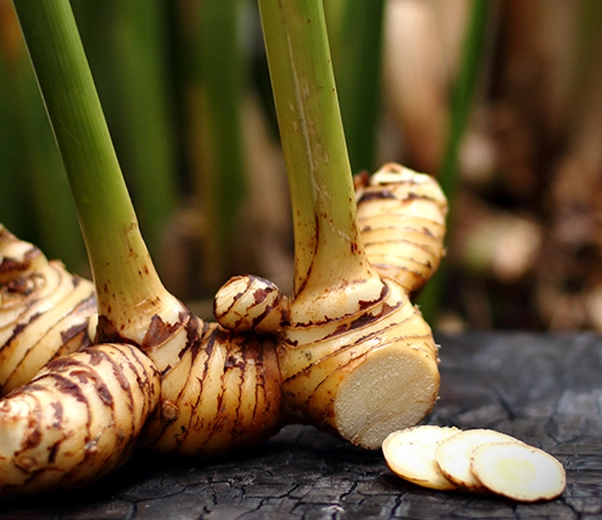
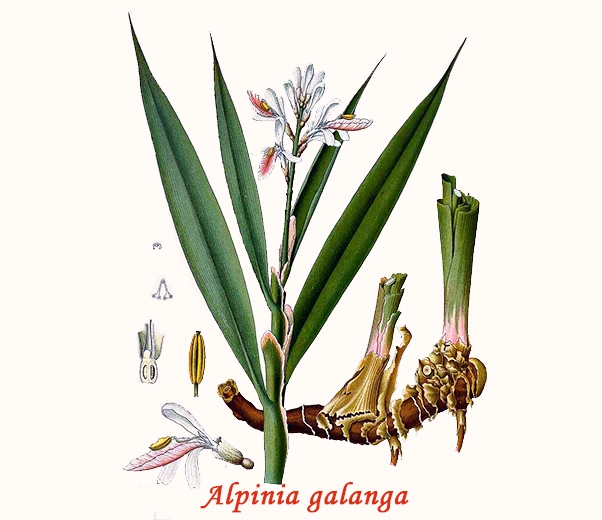
Native to Hainan Island (China), galangal is also known as "Chinese ginger". It is a rhizomatous herbaceous plant similar to the European cane that grows to a height of about one meter, with large leaves and red fruits. It is often confused with both greater galangal (Galanga officinalis) and ginger.
It is cultivated in China, Japan, Indonesia, and Thailand both for culinary purposes (a well-known ingredient in curry) and to obtain its essential oil.
It is cultivated in China, Japan, Indonesia, and Thailand both for culinary purposes (a well-known ingredient in curry) and to obtain its essential oil.
 Black pepper
 Cinnamon bark
 Cinnamon leaves
 Copaiba
 Coriander
 Dwarf mountain pine
 Greek mastic
 Larch
Larch Moroccan chamomile
 Myrrh
Myrrh Myrtle
 Oakmoss
 Opoponax
 Patchouli
 Rosemary
 Fine perfumery fragrances
 Vegetable oils for cosmetic use
 Essence diffusers
 Galangal
 Helichrysum