
Balsam of Peru
Pure essential oil of conventional origin
Confezione: 11.3 ml bottle.
-
12,90 €
✔ 100% pure and natural · Since 1993, selected GMO-free essential oils · Certified quality · Shipping within 24/48h
Essential oils
Made exclusively from pure natural distillates of excellent quality, totally free from stabilizers and/or fixatives of any kind, our essential oils represent the best that can be found by those who, without any “ ifs ” or “ buts ”, demand – in the literal sense of the term – the 100% quintessence of nature .
- Code: 21586
- INCI: Myroxylon pereirae
- CAS: 8007-00-9
- Family: Leguminosae
- Type: pure essential oil (EO)
- Variety: conventional
- Food flavoring: yes (according to EC Regulation 1334/2008)
- Extraction method: dry vacuum distillation
- Purity: 100%
- Origin: El Salvador
Related accessories

Description
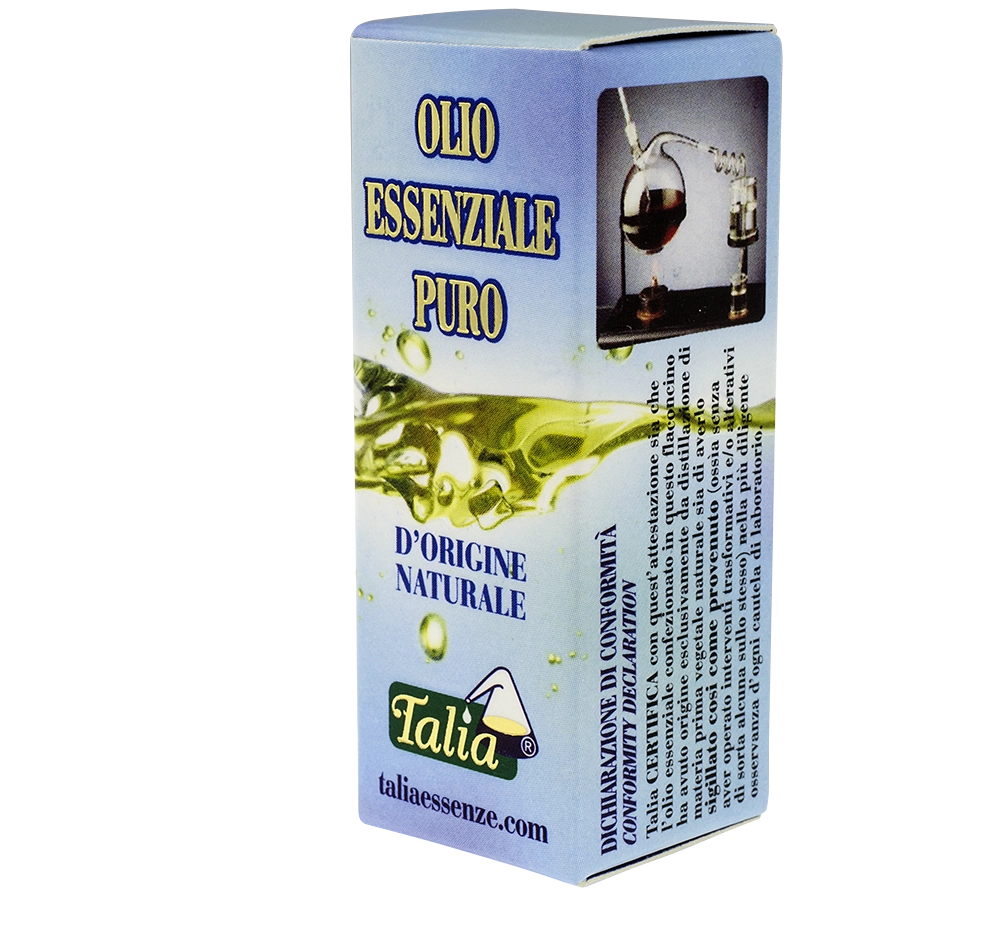
100% pure and concentrated essential oil of natural origin in an 11.3 ml (0.34 fl. oz.) glass bottle ; this product is completely free from: stabilizers, fixatives, pesticides, GMOs and treatments (even of semi-finished products) with gamma rays and has been packaged and sealed as it came, i.e., without having undergone any transformation and/or alteration of any kind and in the most diligent observance of all laboratory precautions. In accordance with EC Regulation 1334/2008 of the European Parliament and of the Council of the European Union, provided they are highly pure, many essential oils (including Balsam of Peru) are declared "food flavourings" and can therefore be taken as supplements.
As per the declaration of conformity published in the brochure, this essential oil was obtained exclusively from the processing of natural plant raw materials. The
information leaflet included with the packaging contains all the information relating to the natural preparation, including the analytical bulletin, the declaration of conformity, the botanical description, the possibility of use as a " food flavoring," etc.
Attention
Absolutely avoid the " do-it-yourself" internal use of essential oils,as this can be highly dangerous. It is advisable to always proceed with a medical prescription issued exclusively by a competent and qualified professional.As per the declaration of conformity published in the brochure, this essential oil was obtained exclusively from the processing of natural plant raw materials. The
information leaflet included with the packaging contains all the information relating to the natural preparation, including the analytical bulletin, the declaration of conformity, the botanical description, the possibility of use as a " food flavoring," etc.
Extraction
Balsam of Peru essential oil is obtained by dry vacuum distillation of the concretioned pathological exudate (balsam) and appears as a very viscous brown liquid with a delicate scent reminiscent of vanilla, woody, sweet, rich and tenacious.
Affinity
Balsam of Peru essential oil harmonizes well with Myrrh and Oakmoss absolutes as well as with the essential oils of: Copaiba, Mastic, Patchouli, Petitgrain, Opoponax, Rose, Styrax and Ylang Ylang.
Properties
Balsam of Peru essential oil, completely non-toxic, has deodorant, fixative, anti-inflammatory, and parasiticide properties. However, the most significant property associated with this natural product is its ability to promote the development of epithelial cells, so much so that it can be considered a true skin regenerator as active as the much better-known argan and rosehip oils. For this reason, it is a popular remedy for eczema.
A "Balsam of Peru essential oil" is often sold commercially, which is very fluid, almost colorless, and has a very mild scent because it is diluted (mostly) in benzyl alcohol.
A "Balsam of Peru essential oil" is often sold commercially, which is very fluid, almost colorless, and has a very mild scent because it is diluted (mostly) in benzyl alcohol.
Uses
Balsam of Peru essential oil is primarily used as a fixative and/or fragrance component in perfumery, cosmetics, soap making, and detergents; it is also used in the food industry, especially in both alcoholic and non-alcoholic beverages.
Botany
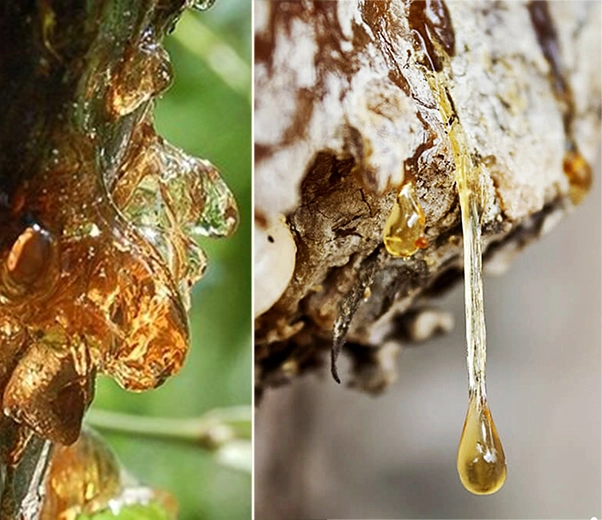
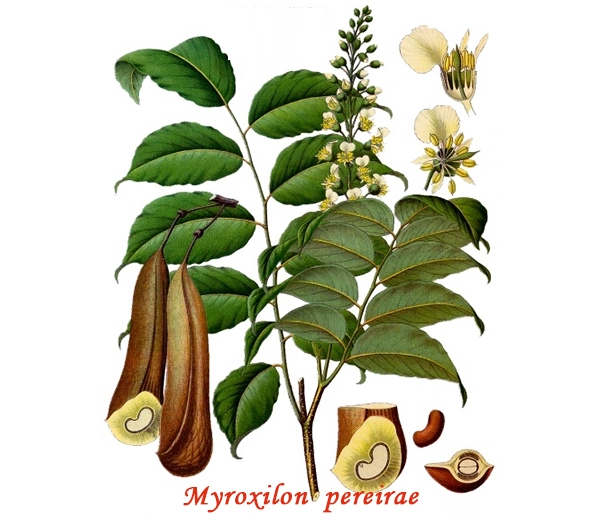
Also known as "Black Balsam", the well-known Balsam of Peru is nothing more than the concretion of the pathological exudate generated by the removal of strips of bark from Myroxylon balsamum, a large tropical tree that grows to twenty-five meters tall. Native to Central America, it has a smooth trunk, rich foliage, and very fragrant flowers. The plant is entirely resinous. Balsam is widely used in medicinal preparations in many tropical countries, especially cough syrups.
 Bulgarian rose
 Coffee roasted beans
 Copaiba
 Costus
 Egyptian papyrus
 Greek mastic
 Liquid storax
 Manuka
 Myrrh
Myrrh Oakmoss
 Opoponax
 Patchouli
 Petitgrain Paraguay
 Turkish rose
 Vanillin
 Ylang-ylang
 Fine perfumery fragrances
 Vegetable oils for cosmetic use
 Essence diffusers
 Balsam of Peru