
Ylang-ylang 1°
Pure and natural essential oil
✔ 100% pure essential oil for industry and laboratory use · Tailored offers
Bulk packaging > Essential oils
A wide range of pure and natural essential oils of guaranteed quality, consistently available for any industrial application.
Highly concentrated natural compounds extracted from various parts of plants such as leaves, inflorescences, twigs, bark, and roots, consisting of the volatile molecules that give different plant species their characteristic aroma.
- Code: T1269
- INCI: Cananga odorata
- CAS: 8006-81-3
- EINECS: 281-092-1
- Family: Annonaceae
- Type: pure essential oil (EO)
- Chemotype: Linalool (minimum 16%)
- Food flavoring: yes (according to EC Regulation 1334/2008)
- Extraction method: water distillation
- Purity: 100%
- Origin: Comoros
Extraction
Ylang ylang essential oil (produced mainly in the Comoros Islands) is obtained by water distillation of freshly picked flowers and appears as a clear yellow liquid with a sweet, warm and intense floral scent, creamy, rich and enveloping.
Properties
A well-known and excellent natural fixative, ylang ylang essential oil is non-toxic and non-irritating. However, it should be used in moderation, as its heady scent can cause headaches and even nausea.
In the Victorian era, it was the basic ingredient in a very popular hair treatment: Macassar oil, a stimulant used to promote hair growth. Effective in the treatment of acne and oily and/or irritated skin thanks to its toning properties, this essential oil is also an excellent anti-infective and antiseptic. It is also an effective remedy for insect bites. Among its various properties, the best-known is certainly that of a powerful aphrodisiac.
It is customary to divide the refining process into three stages to obtain three distinct oils of increasingly lower quality.
It blends well with the essential oils of: Agarwood, Bergamot, Frankincense, Rosewood, Opoponax, Rose and Vetiver.
In the Victorian era, it was the basic ingredient in a very popular hair treatment: Macassar oil, a stimulant used to promote hair growth. Effective in the treatment of acne and oily and/or irritated skin thanks to its toning properties, this essential oil is also an excellent anti-infective and antiseptic. It is also an effective remedy for insect bites. Among its various properties, the best-known is certainly that of a powerful aphrodisiac.
It is customary to divide the refining process into three stages to obtain three distinct oils of increasingly lower quality.
It blends well with the essential oils of: Agarwood, Bergamot, Frankincense, Rosewood, Opoponax, Rose and Vetiver.
Uses
Ylang-ylang essential oil is widely used both as a fragrance component and as a fixative in perfumery, cosmetics, and soap making, especially in floral-exotic products. It is also a widely used flavoring in the food industry (especially in beverages and confectionery).
The relevant technical and safety documentation for the product is available upon request.
The relevant technical and safety documentation for the product is available upon request.
Botany
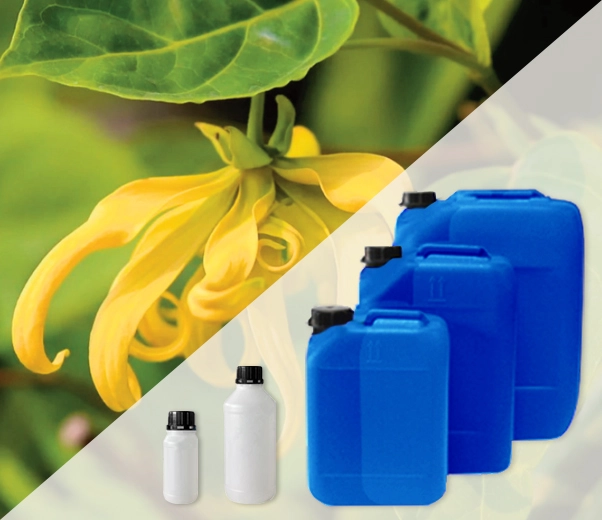
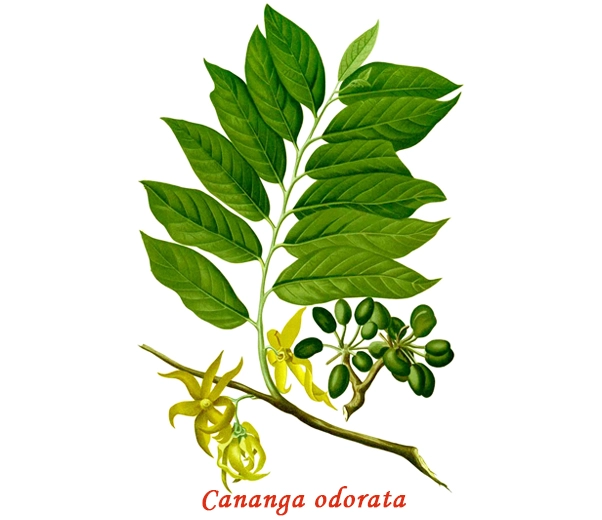
Native to Indonesia and the Philippines, ylang-ylang is also known as the "flower of flowers". It is a large tropical tree, up to twenty meters tall, that thrives in the rainforest. It has long, glossy, dark, lanceolate leaves with wavy edges. In spring and autumn, it produces large, highly fragrant yellow-green flowers with elongated, curled petals.
Related topics
Related products
 Acacia flower
 Agarwood
 Amyris
 Balsam of Peru
 Bergamot
 Bulgarian rose
 Calamus
 Cardamom
 Cinnamon bark
 Cinnamon leaves
 Citron
 Clove
Clove Cost
Cost Dwarf mountain pine
 Eritrean oil
 Gardenia
 Hyacinth
 Italian lemon
 Jasmine
 Lemon zest
 Liquid storax
 Matricaria chamomile
 Mimosa flower
 Mysore sandalwood
 Narcissus
 Neroli
 Opoponax
 Orange blossom
 Oriental Sweet amber
 Palmarosa
 Parsley seeds
 Rosewood
 Sandalwood
 Sudanese incense
 Swiss pine
 Tea tree
 Tuberose
 Turkish rose
 Turmeric
 Vetiver
 Vetiver Haiti
 Wintergreen
 Home fragrances
 Aroma chemicals
 Measuring instruments
 Containers
 Fine perfumery fragrances
 Ylang-ylang 1°