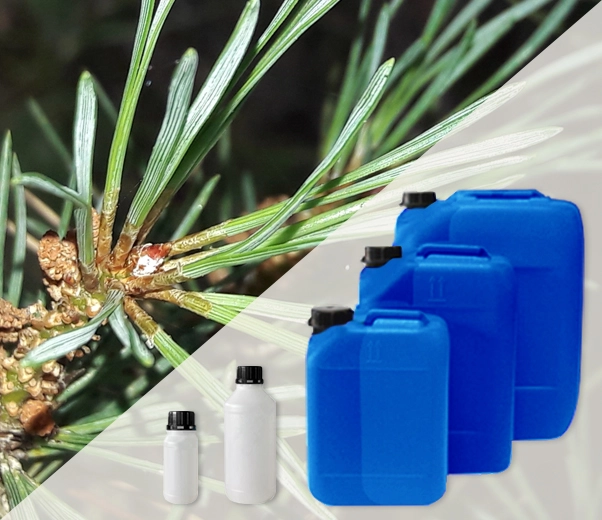

Scots pine
Pure and natural essential oil
✔ 100% pure essential oil for industry and laboratory use · Tailored offers
Bulk packaging > Essential oils
A wide range of pure and natural essential oils of guaranteed quality, consistently available for any industrial application.
Highly concentrated natural compounds extracted from various parts of plants such as leaves, inflorescences, twigs, bark, and roots, consisting of the volatile molecules that give different plant species their characteristic aroma.
- Code: T1540
- INCI: Pinus sylvestris
- CAS: 8023-99-2
- EINECS: 281-679-2
- Family: Pinaceae
- Type: pure essential oil (EO)
- Chemotype: α‑pinene (minimo 30%)
- Food flavoring: yes (according to EC Regulation 1334/2008)
- Extraction method: dry distillation
- Purity: 100%
- Origin: Germany
Extraction
Scots pine essential oil is obtained by dry distillation of needles and branches. It appears as a pale yellow liquid (almost colorless) with a strong, dry, balsamic pine-like scent.
The relevant technical and safety documentation for the product is available upon request.
The relevant technical and safety documentation for the product is available upon request.
Properties
Scots pine essential oil has antiseptic, antiviral, bactericidal, balsamic, and deodorant properties; when used in moderation, it is completely non-toxic and non-irritating. In the past, it was a natural remedy for pediculosis (lice) and was also used as an anti-catarrhal treatment. It blends well with the essential oils of Buchu, Cedar, Clary sage, Copaiba, Cypress, Eucalyptus, Juniper, Lavender, Lemon, Marjoram, Niaouli, Ravensara, Rosemary and Tea tree.
Uses
Siberian pine essential oil is commonly used in cosmetics, soaps, and personal hygiene products (especially bath products). The food industry sometimes uses it as a flavoring ingredient in alcoholic and non-alcoholic beverages.
Botany
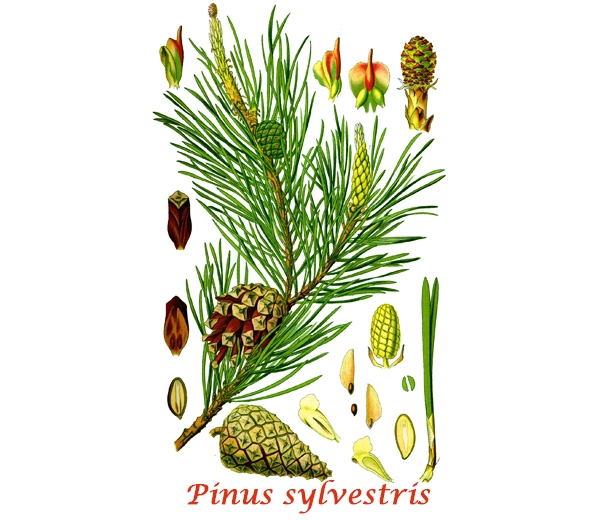
Commonly known as the "common pine", the Scots pine is native to Eurasia. It is a large evergreen tree, up to forty meters tall, with long, stiff needle-like leaves, deeply fissured reddish-brown bark, and pointed cones. It is cultivated in Russia, Scandinavia, Finland, and the United States primarily for its modest timber and turpentine.
Related topics
Related products
 Artemisia
 Bay laurel
 Buchu
Buchu Celery
 Cistus
 Citron
 Clary sage
 Classic musk
 Copaiba
 Coriander
 Cypress
 English lavender
 Eucalyptus
 Green ivy
 Italian lemon
 Juniper berries
 Larch
Larch Lemon eucalyptus
 Lemon skin
 Lemongrass
 Marjoram
 Niaouli
 Oregano
 Pale rose
 Ravensara
 Rosemary
 SavoUry
 Scots pine
 Sea breeze
 Silver fir
 Sour flowers
 Spruce
 Tea tree
 Tropical scent
 Valerian
 Vanilla
 Wild meadow
 Woodland flowers
 Yarrow
 Home fragrances
 Aroma chemicals
 Measuring instruments
 Containers
 Fine perfumery fragrances
 Scots pine
 Dill
Dill