
Pink pepper
Pure and natural essential oil
✔ 100% pure essential oil for industry and laboratory use · Tailored offers
Bulk packaging > Essential oils
A wide range of pure and natural essential oils of guaranteed quality, consistently available for any industrial application.
Highly concentrated natural compounds extracted from various parts of plants such as leaves, inflorescences, twigs, bark, and roots, consisting of the volatile molecules that give different plant species their characteristic aroma.
- Code: T1595
- INCI: Schinus terebinthifolius
- CAS: 949495-68-5
- EINECS: 481-880-7
- Family: Anacardiaceae
- Type: pure essential oil (EO)
- Chemotype: δ-3-carene (about 30%)
- Food flavoring: No
- Extraction method: steam distillation
- Purity: 100%
- Origin: Brazil
Extraction
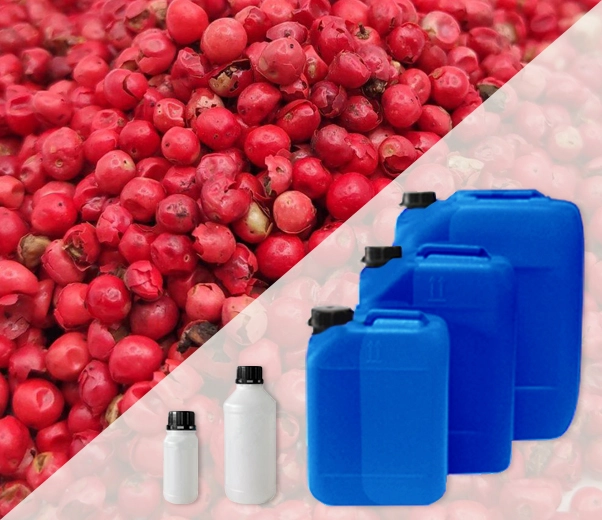
Pink pepper essential oil is obtained by steam distillation of ripe berries and appears as a pale yellow liquid with an unmistakable sweet, fresh, spicy scent with a woody undertone.
Properties
Pink pepper essential oil, non-toxic but slightly irritating, has analgesic, antimicrobial, anti-inflammatory, and antipyretic properties. It should be used with caution on the skin, as it can cause sensitization. It is therefore a good idea to mix it with a vegetable oil such as sweet almond or sesame oil.
When used in a diffuser, this natural extract can act as a mood tonic (calming), even helping to control stubborn addictions such as smoking.
It blends well with the essential oils of cinnamon leaves, clove, mastic, nutmeg, opoponax, oregano, mountain pine, ravensara, and styrax.
When used in a diffuser, this natural extract can act as a mood tonic (calming), even helping to control stubborn addictions such as smoking.
It blends well with the essential oils of cinnamon leaves, clove, mastic, nutmeg, opoponax, oregano, mountain pine, ravensara, and styrax.
Uses
Pink pepper essential oil is used as an unusual fragrance component in perfumery, cosmetics, and woody-spicy soaps, often as a substitute for black pepper oil. In South America, it is primarily used in agriculture as a valuable ingredient in the formulation of natural pesticides.
The product's technical and safety documentation is available upon request.
The product's technical and safety documentation is available upon request.
Botany
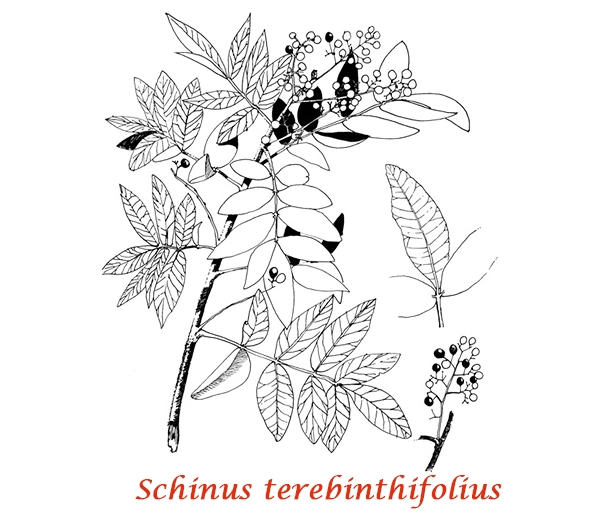
Native to tropical and subtropical South America (especially Argentina, southeastern Brazil, and Paraguay), pink pepper is also known as "Brazilian pepper" or "false pepper."
It is a shrub that can grow to over ten meters tall, with serrated, oval leaves and small, white flowers clustered in clusters. It is a highly prized ornamental plant, thanks to both its elegant foliage and its decorative fruits, consisting of aromatic, scarlet-red berries (when ripe). However, due to its remarkable adaptability to diverse environments (found from dunes to swamps), it is feared for its tendency to colonize the natural habitat of other native species, eventually replacing them.
It is a shrub that can grow to over ten meters tall, with serrated, oval leaves and small, white flowers clustered in clusters. It is a highly prized ornamental plant, thanks to both its elegant foliage and its decorative fruits, consisting of aromatic, scarlet-red berries (when ripe). However, due to its remarkable adaptability to diverse environments (found from dunes to swamps), it is feared for its tendency to colonize the natural habitat of other native species, eventually replacing them.
 Cinnamon leaves
 Dwarf mountain pine
 Greek mastic
 Liquid storax
 Magnolia flower
 Nutmeg
 Opoponax
 Oregano
 Palo Santo fruit
 Ravensara
 Home fragrances
 Aroma chemicals
 Measuring instruments
 Containers
 Fine perfumery fragrances
 Pink pepper