
Patchouli
Pure and natural essential oil
✔ 100% pure essential oil for industry and laboratory use · Tailored offers
Bulk packaging > Essential oils
A wide range of pure and natural essential oils of guaranteed quality, consistently available for any industrial application.
Highly concentrated natural compounds extracted from various parts of plants such as leaves, inflorescences, twigs, bark, and roots, consisting of the volatile molecules that give different plant species their characteristic aroma.
- Code: T1249
- INCI: Pogostemon cablin
- CAS: 8014-09-3
- EINECS: 282-493-4
- Family: Lamiaceae
- Type: pure essential oil (EO)
- Chemotype: Patchoulol (approximately 25%)
- Food flavoring: yes (according to EC Regulation 1334/2008)
- Extraction method: steam distillation
- Purity: 100%
- Origin: Indonesia
Extraction
Patchouli essential oil is obtained by steam distillation of the dried and fermented leaves of the plant; it appears as a dark, orange-brown, viscous liquid with a distinctive, rich, and sweet, herbaceous-earthy scent. The scent, somewhat reminiscent of mold, intensifies with age.
Properties
Patchouli essential oil, a well-known natural fungicide, has proven antifungal, antiseptic, anti-inflammatory, and stimulating properties, as well as being an effective insect repellent. It is also prized for its antidepressant and aphrodisiac properties, which have been attributed to it for centuries.
In the East, it is still common to treat seborrhea of the scalp by rubbing it with patchouli oil, thanks to its proven trichological properties. Deodorizing clothes and linens with this product, rightly considered an effective prophylactic, has also been practiced for a very long time.
It blends well with benzoin absolute as well as the essential oils of agarwood, ambrette, bergamot, bucchus, cinnamon, cedar, cistus, copaiba, frankincense, myrrh, opoponax, ravensara, clary sage, and vetiver.
In the East, it is still common to treat seborrhea of the scalp by rubbing it with patchouli oil, thanks to its proven trichological properties. Deodorizing clothes and linens with this product, rightly considered an effective prophylactic, has also been practiced for a very long time.
It blends well with benzoin absolute as well as the essential oils of agarwood, ambrette, bergamot, bucchus, cinnamon, cedar, cistus, copaiba, frankincense, myrrh, opoponax, ravensara, clary sage, and vetiver.
Uses
Patchouli essential oil is used in cosmetics and perfumery both as a fragrance component and as a fixative. Oriental-inspired soaps and cosmetics often contain a fraction of this essential oil in their formulas. It is also widely used in the food industry, both in the production of alcoholic and non-alcoholic beverages and as a masking agent.
The relevant technical and safety documentation for the product is available upon request.
The relevant technical and safety documentation for the product is available upon request.
Botany
Native to tropical Asia (Indonesia and the Philippines), patchouli is widely cultivated—beyond its native regions—in China, India, Thailand, and Malaysia, both for its oil and as an antidote to venomous snakebites.
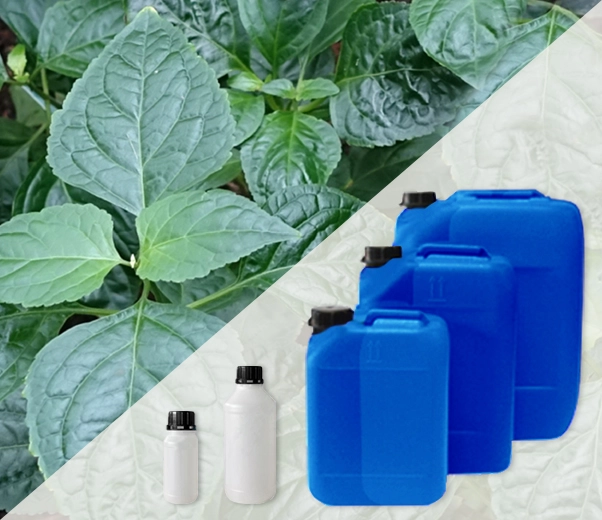
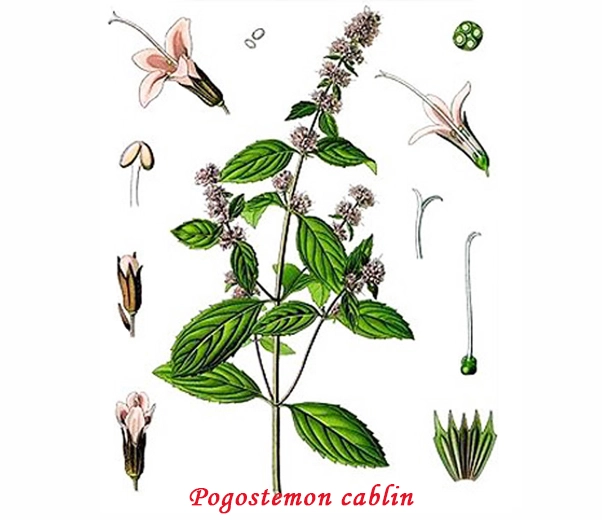
It is a bushy herbaceous plant that grows to nearly a meter tall, with a sturdy stem, large, fragrant leaves, and white, purplish-red flowers clustered in spikes.
It is a bushy herbaceous plant that grows to nearly a meter tall, with a sturdy stem, large, fragrant leaves, and white, purplish-red flowers clustered in spikes.
Related topics
Related products
 African geranium
 Agarwood
 Ambrette seeds
 Angelica seeds
 Artemisia
 Balsam of Peru
 Benzoin
 Bergamot
 Birch
Birch Buchu
Buchu Bulgarian rose
 Calamus
 Cedar wood
 Cinnamon bark
 Cinnamon leaves
 Cistus
 Citron
 Civet
Civet Clary sage
 Copaiba
 Cost
Cost English lavender
 Galangal
 Ginger
 Lavender in bloom
 Matricaria chamomile
 Mimosa flower
 Myrrh
Myrrh Myrrh
Myrrh Mysore sandalwood
 Opoponax
 Ravensara
 Sandalwood
 Sudanese incense
 Turkish rose
 Turkish rose
 Valerian
 Vetiver
 Vetiver Haiti
 Home fragrances
 Aroma chemicals
 Measuring instruments
 Containers
 Fine perfumery fragrances
 Patchouli