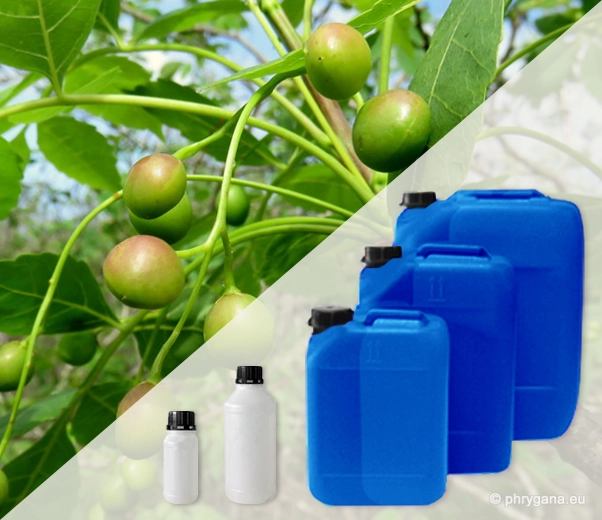

Palo Santo fruit
Pure and natural essential oil
✔ 100% pure essential oil for industry and laboratory use · Tailored offers
Bulk packaging > Essential oils
A wide range of pure and natural essential oils of guaranteed quality, consistently available for any industrial application.
Highly concentrated natural compounds extracted from various parts of plants such as leaves, inflorescences, twigs, bark, and roots, consisting of the volatile molecules that give different plant species their characteristic aroma.
- Code: T1589
- INCI: Bursera graveolens
- CAS: 959130-05-3
- EINECS: 934-174-2
- Family: Burseraceae
- Type: pure essential oil (EO)
- Chemotype: δ-limonene (minimum 60%)
- Food flavoring: yes (according to EC Regulation 1334/2008)
- Extraction method: steam distillation
- Purity: 100%
- Origin: Southern Ecuador
Extraction
The most common commercially available Palo Santo oil is obtained by steam distilling the wood shavings of the tree. A much rarer and more valuable essential oil (this one) is extracted, again through steam distillation, from the ripe fruits; it is a nearly colorless liquid with an intense, warm, sweet, creamy-spicy aroma reminiscent of pepper with a vaguely citrusy undertone, truly unmistakable.
Properties
Palo Santo fruit essential oil, non-toxic and non-irritating, has antiseptic, anti-inflammatory, and antifungal properties; it is also an effective insect repellent and a beneficial anxiolytic (the latter properties can be enjoyed using a simple diffuser).
It is also a traditional remedy for wounds.
It blends well with jasmine and myrrh absolutes as well as the essential oils of ambrette, clove, galbanum, frankincense, pink pepper, mountain pine, opoponax, rose, sandalwood, and styrax.
It is also a traditional remedy for wounds.
It blends well with jasmine and myrrh absolutes as well as the essential oils of ambrette, clove, galbanum, frankincense, pink pepper, mountain pine, opoponax, rose, sandalwood, and styrax.
Uses
The essential oil obtained from Palo Santo fruit is occasionally used in artisanal cosmetics and perfumery as an unusual fragrance component with woody-spicy notes. Industrial uses of this unusual raw material are limited due to its scarcity on the market.
The relevant technical and safety documentation for the product is available upon request.
The relevant technical and safety documentation for the product is available upon request.
Botany
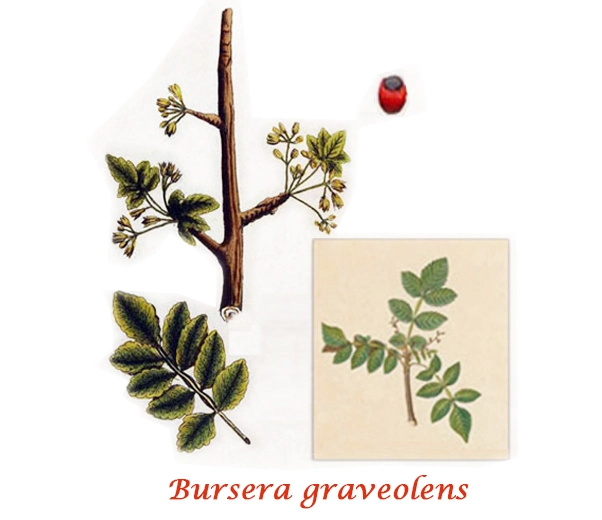
Also known in English-speaking countries as "Holy Wood", Palo Santo is native to Mexico's Yucatan Peninsula; it grows wild throughout most of Central and South America. It is a dry shrub that can reach over ten meters in height, with smooth, gray bark, pinnate leaves, white flowers, and ovoid fruits that turn red as they ripen.
Botanically, it is a direct relative of Frankincense from the Horn of Africa.
The plant's name, of Spanish origin, means "Sacred Stick", due to its age-old ritual (and also therapeutic) use by numerous Indo-American cultures, whose shamans, to this day, still light it to release its renowned aromatic fumigations. It is thought that the Incas' ceremonial "sacred fires" were fueled with Palo Santo wood.
It now seems certain that the essential oil obtained from Palo Santo from the south-Ecuadorian regions has distinct characteristics and is of extremely high quality.
Botanically, it is a direct relative of Frankincense from the Horn of Africa.
The plant's name, of Spanish origin, means "Sacred Stick", due to its age-old ritual (and also therapeutic) use by numerous Indo-American cultures, whose shamans, to this day, still light it to release its renowned aromatic fumigations. It is thought that the Incas' ceremonial "sacred fires" were fueled with Palo Santo wood.
It now seems certain that the essential oil obtained from Palo Santo from the south-Ecuadorian regions has distinct characteristics and is of extremely high quality.
 Ambrette seeds
 Bulgarian rose
 Clove
Clove Dwarf mountain pine
 Jasmine
 Jasmine
 Levant Galbanum
 Liquid storax
 Myrrh
Myrrh Myrrh
Myrrh Mysore sandalwood
 Opoponax
 Pink pepper
 Rue
Rue Sudanese incense
 Turkish rose
 Home fragrances
 Aroma chemicals
 Measuring instruments
 Containers
 Fine perfumery fragrances
 Palo Santo fruit