
Oregano
Pure and natural essential oil
✔ 100% pure essential oil for industry and laboratory use · Tailored offers
Bulk packaging > Essential oils
A wide range of pure and natural essential oils of guaranteed quality, consistently available for any industrial application.
Highly concentrated natural compounds extracted from various parts of plants such as leaves, inflorescences, twigs, bark, and roots, consisting of the volatile molecules that give different plant species their characteristic aroma.
- Code: T1534
- INCI: Origanum vulgare
- CAS: 8007-11-2
- EINECS: 281-670-3
- Family: Lamiaceae
- Type: pure essential oil (EO)
- Chemotype: Carvacrol (approximately 65%)
- Food flavoring: yes (according to EC Regulation 1334/2008)
- Extraction method: steam distillation
- Purity: 100%
- Origin: Spain
Extraction
Oregano essential oil is obtained by steam distillation of the dried flowering plant. It appears as a pale yellow liquid (which turns brown as it ripens) with an unmistakable warm, spicy, and herbaceous aroma.
Properties
Oregano essential oil has strong antimicrobial, antiviral, fungicidal, and rubefacient properties. In the past, it was used as a dermatological medication to treat insect bites. Toxic, irritating, and notoriously stinging, it should never be applied directly to the skin, but only in low concentrations, diluted in a vegetable oil (such as almond or sesame).
It blends well with the essential oils of camphor, cedar, citronella, lavender, pine, ravensara, rosemary, as well as oakmoss absolute.
It blends well with the essential oils of camphor, cedar, citronella, lavender, pine, ravensara, rosemary, as well as oakmoss absolute.
Uses
Oregano essential oil is typically used as a fragrance component in soaps, colognes, and perfumes (especially men's fragrances), as well as in the food industry as a meat flavoring.
The relevant technical and safety documentation for the product is available upon request.
The relevant technical and safety documentation for the product is available upon request.
Botany
Native to Europe, oregano is now cultivated worldwide.
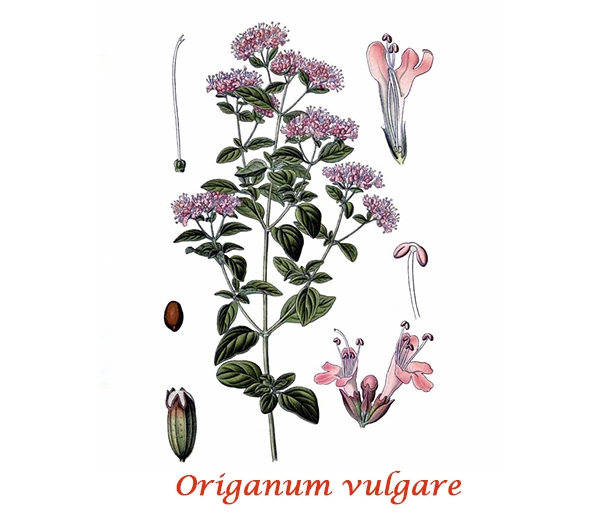
It is a creeping herbaceous plant with a woody stem that grows up to ninety centimeters tall, with small, dark green leaves and pinkish-white flowers.
There are over thirty varieties, and perhaps for this reason, it is often classified botanically inaccurately (it is often confused with marjoram).
It is a creeping herbaceous plant with a woody stem that grows up to ninety centimeters tall, with small, dark green leaves and pinkish-white flowers.
There are over thirty varieties, and perhaps for this reason, it is often classified botanically inaccurately (it is often confused with marjoram).
 Apple mint
 Cade
Cade Camphor
 Citron
 Dwarf mountain pine
 English lavender
 Garlic
 Lemongrass
 Mustard
 Oakmoss
 Pink pepper
 Ravensara
 Rosemary
 Scots pine
 Siberian pine
 Swiss pine
 Wintergreen
 Home fragrances
 Aroma chemicals
 Measuring instruments
 Containers
 Fine perfumery fragrances
 Oregano