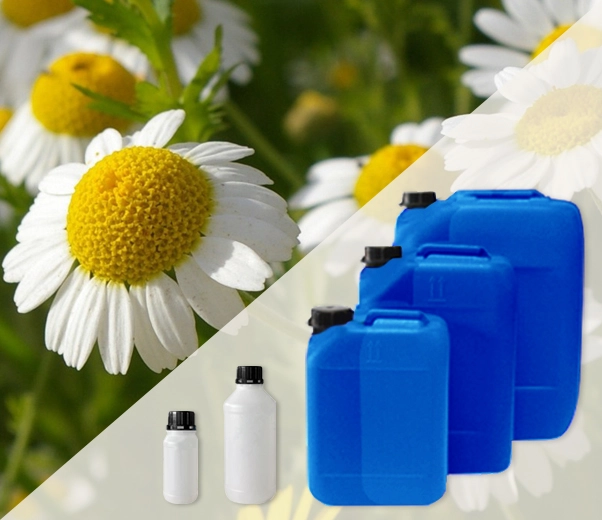

Matricaria chamomile
Pure and natural essential oil
✔ 100% pure essential oil for industry and laboratory use · Tailored offers
Bulk packaging > Essential oils
A wide range of pure and natural essential oils of guaranteed quality, consistently available for any industrial application.
Highly concentrated natural compounds extracted from various parts of plants such as leaves, inflorescences, twigs, bark, and roots, consisting of the volatile molecules that give different plant species their characteristic aroma.
- Code: T1510
- INCI: Chamomilla recutita
- CAS: 8002-66-2
- EINECS: 282-006-5
- Family: Asteraceae
- Type: pure essential oil (EO)
- Chemotype: α-bisabolol (minimum 45%)
- Food flavoring: yes (according to EC Regulation 1334/2008)
- Extraction method: steam distillation
- Purity: 100%
- Origin: Europe
Extraction
Matricaria chamomile essential oil is obtained by steam distillation of the inflorescences (the yield is less than 2%). It appears as a viscous, ink-blue liquid with a powerful, warm, and sweet herbaceous scent.
Properties
Non-toxic and non-irritating, Chamomile essential oil has traditionally been used, thanks to its outstanding antiseptic properties, in the treatment of wounds, burns, insect bites, and acne-prone skin. In aromatherapy, it is regarded as an effective remedy for headaches and insomnia.
It blends well with the essential oils of: African Geranium, Bergamot, Cistus, Clary sage, Lavender, Lemon, Marjoram, Neroli, Patchouli, Rose, and Ylang-ylang, as well as with Benzoin absolute.
It blends well with the essential oils of: African Geranium, Bergamot, Cistus, Clary sage, Lavender, Lemon, Marjoram, Neroli, Patchouli, Rose, and Ylang-ylang, as well as with Benzoin absolute.
Uses
An excellent fixative, Chamomile essential oil is used in pharmacy (formulation of antiseptic ointments and tonic preparations) as well as a fragrance component in fine perfumery, cosmetics and soap making.
The technical and safety documentation relating to the product is available upon request.
The technical and safety documentation relating to the product is available upon request.
Botany
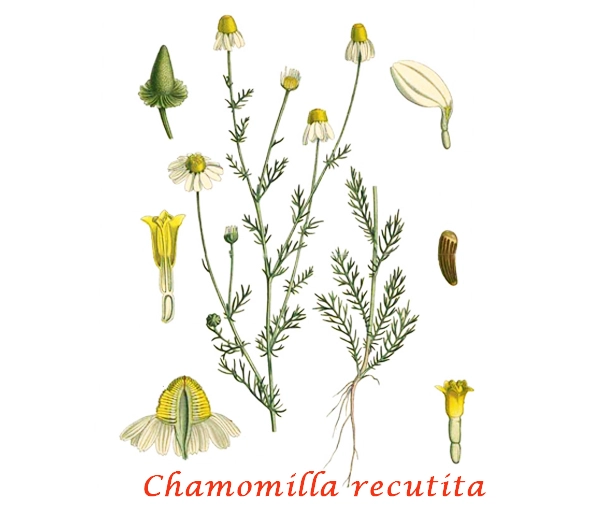
Also known as "German chamomile", matricaria Chamomile is native to Europe and northwestern Asia. Today, it is widely cultivated in Eastern Europe, especially in Hungary. It is a highly aromatic herbaceous plant, up to sixty centimeters tall, with an erect stem, laciniate leaves, and white daisy-like inflorescences.
It grows wild in meadows and open countryside, where it often becomes a weed.
It grows wild in meadows and open countryside, where it often becomes a weed.
 African geranium
 Benzoin
 Bergamot
 Bulgarian rose
 Cistus
 Clary sage
 English lavender
 Helichrysum
 Italian lemon
 Lemon zest
 Linden flower
 Marjoram
 Neroli
 Orange blossom
 Patchouli
 Turkish rose
 Yarrow
 Ylang-ylang 1°
 Home fragrances
 Aroma chemicals
 Measuring instruments
 Containers
 Fine perfumery fragrances
 Matricaria chamomile
 Lemongrass