
Liquid storax
Pure and natural essential oil
✔ 100% pure essential oil for industry and laboratory use · Tailored offers
Bulk packaging > Essential oils
A wide range of pure and natural essential oils of guaranteed quality, consistently available for any industrial application.
Highly concentrated natural compounds extracted from various parts of plants such as leaves, inflorescences, twigs, bark, and roots, consisting of the volatile molecules that give different plant species their characteristic aroma.
- Code: T1583
- INCI: Liquidambar styraciflua
- CAS: 8024-01-9
- EINECS: 305-628-1
- Family: Altingiaceae
- Type: pure essential oil (EO)
- Chemotype: Styrene cinnamate (minimum 33%)
- Food flavoring: No
- Extraction method: steam distillation
- Purity: 100%
- Origin: Mexico
Extraction
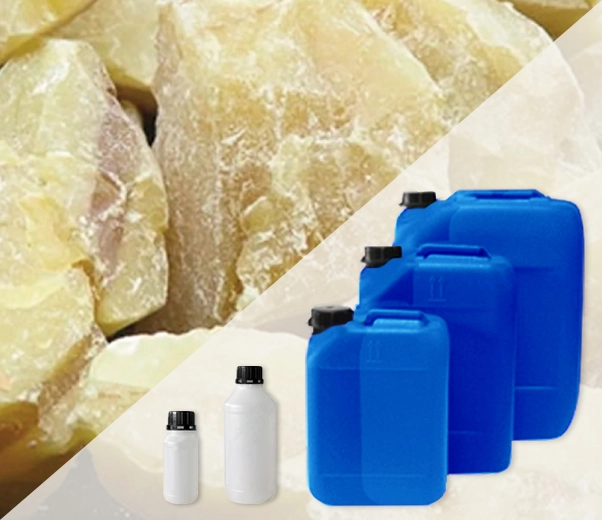
Styrax essential oil is obtained by steam distillation of the resin, a pathological exudation of the shrub secreted by the beaten and incised bark; it appears as a dark, viscous, reddish-brown liquid, with a typical sweet-balsamic, spicy, resinous, rich, and tenacious aroma.
Properties
Styrax essential oil, non-toxic and non-irritating, has bactericidal, balsamic, anti-inflammatory, cough suppressant, expectorant, and stimulant properties. It is also a traditional remedy for scabies and is also effective in treating certain sexually transmitted infections and wound healing.
It blends well with jasmine and myrrh absolutes as well as the essential oils of clove, cinnamon, frankincense, lavender, opoponax, rose, and ylang-ylang.
It blends well with jasmine and myrrh absolutes as well as the essential oils of clove, cinnamon, frankincense, lavender, opoponax, rose, and ylang-ylang.
Uses
Styrax essential oil is primarily used in perfumery as a fragrance component and as a fixative in oriental-floral notes, often used in soap making. It is also used as a flavoring ingredient in the alcoholic and non-alcoholic beverage industry.
The relevant technical and safety documentation for the product is available upon request.
The relevant technical and safety documentation for the product is available upon request.
Botany
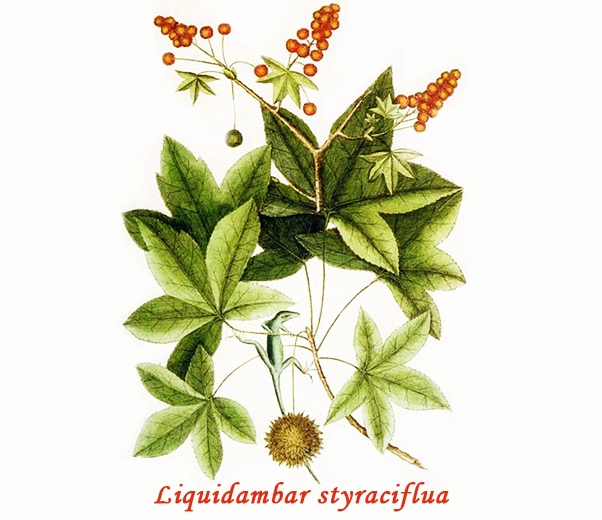
Native to the southeastern United States, Liquidambar stiraciflua is also known as "liquid amber" or "American red gum". It is a monumental deciduous tree that can reach over thirty meters in height, with gray-purple bark, five-lobed leaves (which turn orange to scarlet-red in autumn), and white flowers. It grows wild in the tropical forests of Central America (in the Honduran department of Olancho).
It is related to the European "Liquidambar orientalis" (the plant that gives rise to black storax, the well-known aromatic balsam of Asia Minor).
It owes its botanical name to the amber-colored resin with a sweet-balsamic scent that drips from its bark (specially incised), which has been known for centuries by Native American populations, especially for its healing properties. It should be noted that the name "Storace" attributed to it is in fact completely inappropriate since phytologically it has nothing to do with the genus Styrax (to which, for example, Benzoin belongs).
It is related to the European "Liquidambar orientalis" (the plant that gives rise to black storax, the well-known aromatic balsam of Asia Minor).
It owes its botanical name to the amber-colored resin with a sweet-balsamic scent that drips from its bark (specially incised), which has been known for centuries by Native American populations, especially for its healing properties. It should be noted that the name "Storace" attributed to it is in fact completely inappropriate since phytologically it has nothing to do with the genus Styrax (to which, for example, Benzoin belongs).
Related topics
Related products
 Balsam of Peru
 Bulgarian rose
 Cade
Cade Cinnamon bark
 Cinnamon leaves
 Coffee roasted seeds
 English lavender
 Eritrean oil
 Indian Spikenard
 Jasmine
 Jasmine
 Levant Galbanum
 Magnolia flower
 Musk oil
 Myrrh
Myrrh Myrrh
Myrrh Opoponax
 Palo Santo fruit
 Pink pepper
 Rue
Rue Sudanese incense
 Tonka bean
 Turkish rose
 White Musk
 Ylang-ylang 1°
 Home fragrances
 Aroma chemicals
 Measuring instruments
 Containers
 Fine perfumery fragrances
 Liquid storax