
Levant Galbanum
Pure and natural essential oil
✔ 100% pure essential oil for industry and laboratory use · Tailored offers
Bulk packaging > Essential oils
A wide range of pure and natural essential oils of guaranteed quality, consistently available for any industrial application.
Highly concentrated natural compounds extracted from various parts of plants such as leaves, inflorescences, twigs, bark, and roots, consisting of the volatile molecules that give different plant species their characteristic aroma.
- Code: T1590
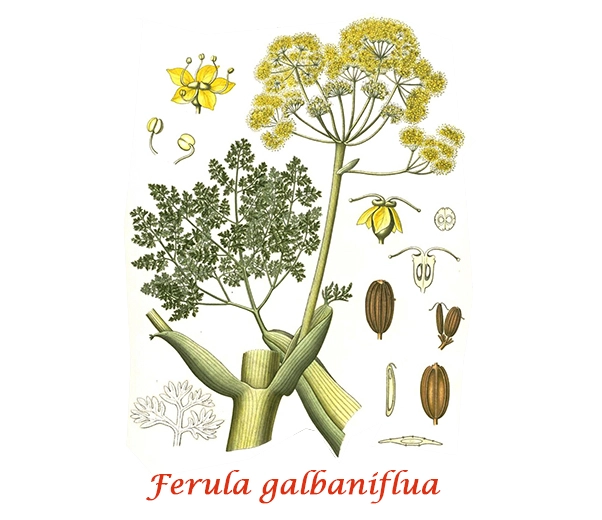
- INCI: Ferula galbaniflua
- CAS: 8023-91-4
- EINECS: 232-532-6
- Family: Apiaceae
- Type: pure essential oil (EO)
- Chemotype: β-pinene (minimum 50%)
- Food flavoring: yes (according to EC Regulation 1334/2008)
- Extraction method: steam distillation
- Purity: 100%
- Origin: Iran
Extraction
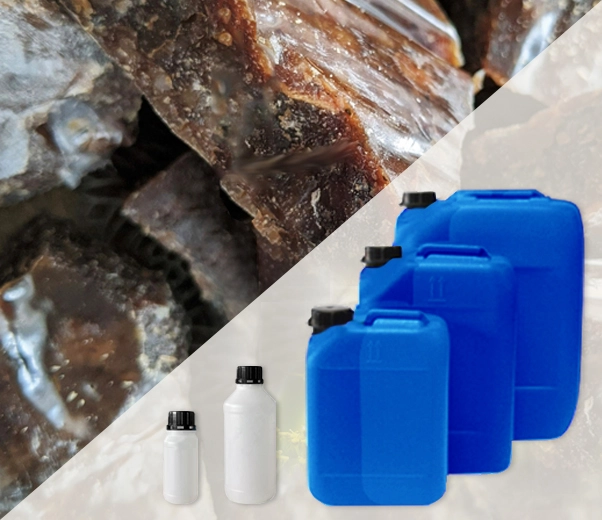
Galbanum essential oil is obtained by steam distillation of the oleoresin and appears as a colorless or light olive liquid with a very dry, penetrating, woody, dry, green odor with a balsamic undertone.
Properties
Galbanum essential oil, completely non-toxic, has antiseptic and balsamic properties. However, its best-known virtues are its dermatological properties, as it is a tonic, a powerful healing agent, a skin preservative, and a proven anti-inflammatory. Thanks to these properties, it has long been a traditional remedy for treating wounds. Finally, it should be noted that herbal tradition even attributes its aphrodisiac properties.
It blends well with myrrh and oakmoss absolutes, as well as with the essential oils of copaiba, geranium, lavender, mastic, nutmeg, black pepper, mountain pine, opoponax, and styrax.
It blends well with myrrh and oakmoss absolutes, as well as with the essential oils of copaiba, geranium, lavender, mastic, nutmeg, black pepper, mountain pine, opoponax, and styrax.
Uses
Galbanum essential oil is primarily used as a fixative (or fragrance component) in perfumery, cosmetics, soap making, and detergents. Both the oil and the oleoresin are also used in the beverage industry, both alcoholic and non-alcoholic.
The relevant technical and safety documentation for the product is available upon request.
The relevant technical and safety documentation for the product is available upon request.
Botany
Native to the Middle East, galbanum is also known as "bubonion" or "ferula gummosa."
It is a large, herbaceous perennial plant with a smooth stem, shiny leaves, and small flowers. It has resin ducts that exude a natural oleoresin in the form of a milky sap, which, when solidified, produces the well-known "gum galbanum" or "gum of Persia". This natural exudate was used by ancient civilizations as incense, in the preparation of cosmetics and perfumes, and as an ingredient in embalming (by the ancient Egyptians).
The shrub is grown in Iran, Lebanon, and Turkey, and two main varieties are known: Persian galbanum and Levantine galbanum, the latter being the only resin from which essential oil is obtained.
It is a large, herbaceous perennial plant with a smooth stem, shiny leaves, and small flowers. It has resin ducts that exude a natural oleoresin in the form of a milky sap, which, when solidified, produces the well-known "gum galbanum" or "gum of Persia". This natural exudate was used by ancient civilizations as incense, in the preparation of cosmetics and perfumes, and as an ingredient in embalming (by the ancient Egyptians).
The shrub is grown in Iran, Lebanon, and Turkey, and two main varieties are known: Persian galbanum and Levantine galbanum, the latter being the only resin from which essential oil is obtained.
 African geranium
 Black pepper
 Copaiba
 Dwarf mountain pine
 English lavender
 Greek mastic
 Liquid storax
 Myrrh
Myrrh Nutmeg
 Oakmoss
 Opoponax
 Palo Santo fruit
 Home fragrances
 Aroma chemicals
 Measuring instruments
 Containers
 Fine perfumery fragrances
 Levant Galbanum
 Yume-no-yume