

Green tangerine
Pure and natural essential oil
✔ 100% pure essential oil for industry and laboratory use · Tailored offers
Bulk packaging > Essential oils
A wide range of pure and natural essential oils of guaranteed quality, consistently available for any industrial application.
Highly concentrated natural compounds extracted from various parts of plants such as leaves, inflorescences, twigs, bark, and roots, consisting of the volatile molecules that give different plant species their characteristic aroma.
- Code: T1233
- INCI: Citrus reticulata
- CAS: 8008-31-9
- EINECS: 284-521-0
- Family: Rutaceae
- Type: pure essential oil (EO)
- Chemotype: δ-limonene (minimum 70%)
- Food flavoring: yes (according to EC Regulation 1334/2008)
- Extraction method: cold pressing
- Purity: 100%
- Origin: Italy (Sicily)
Extraction
Mandarin essential oil is obtained by cold pressing the fresh peel of the unripe fruit and appears as a clear, intense green liquid with a fresh, citrusy, almost floral, and very distinctive scent.
Properties
Mandarin essential oil, non-toxic and non-irritating, is an effective remedy for acne and oily skin; however, when applying it to the skin, avoid sunlight, as it is mildly phototoxic.
In the past, this essential oil was also used to combat insomnia and nervous tension.
It blends well with all citrus oils (particularly neroli) as well as with spicy oils such as cinnamon, clove, and nutmeg.
In the past, this essential oil was also used to combat insomnia and nervous tension.
It blends well with all citrus oils (particularly neroli) as well as with spicy oils such as cinnamon, clove, and nutmeg.
Uses
Mandarin essential oil is commonly used today as a fragrance component in cosmetics, perfumery, and soap making, as well as a flavoring agent in confectionery, soft drinks, and liqueurs.
The relevant technical and safety documentation for the product is available upon request.
The relevant technical and safety documentation for the product is available upon request.
Botany
Native to southern China and brought to Europe in 1805, the mandarin is now grown primarily in Italy, Spain, Algeria, and Brazil.
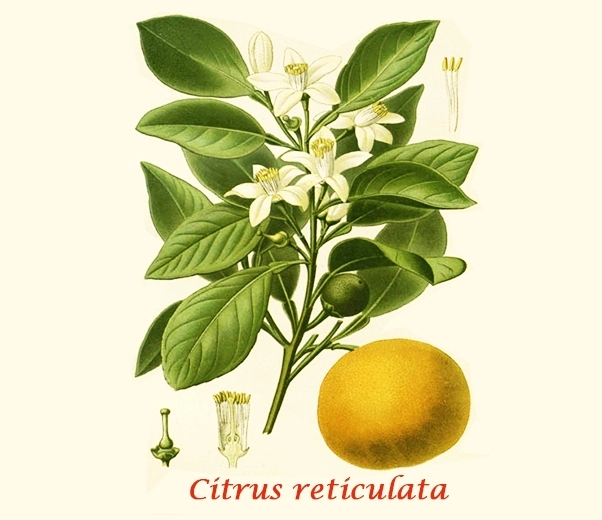
It is a small evergreen tree with glossy leaves, fragrant flowers, and plump fruit.
Its name comes from the fact that its fruit was traditionally given to ancient officials of imperial China, known as "Mandarins."
It is a small evergreen tree with glossy leaves, fragrant flowers, and plump fruit.
Its name comes from the fact that its fruit was traditionally given to ancient officials of imperial China, known as "Mandarins."
 Cinnamon bark
 Cinnamon leaves
 Clove
Clove Cypress
 Larch
Larch Myrrh
Myrrh Myrrh
Myrrh Neroli
 Nutmeg
 Talcus citratus
 Valerian
 Home fragrances
 Aroma chemicals
 Measuring instruments
 Containers
 Fine perfumery fragrances
 Green tangerine