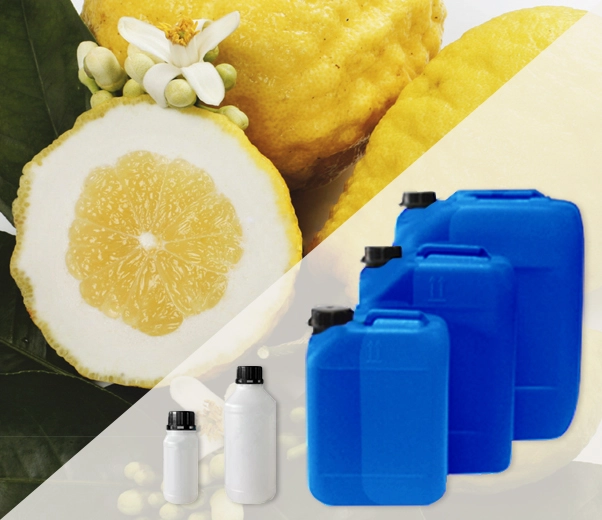

Citron
Pure and natural essential oil
✔ 100% pure essential oil for industry and laboratory use · Tailored offers
Bulk packaging > Essential oils
A wide range of pure and natural essential oils of guaranteed quality, consistently available for any industrial application.
Highly concentrated natural compounds extracted from various parts of plants such as leaves, inflorescences, twigs, bark, and roots, consisting of the volatile molecules that give different plant species their characteristic aroma.
- Code: T1210
- INCI: Citrus cedra
- CAS: 93685-55-3
- EINECS: 296-175-8
- Family: Rutaceae
- Type: pure essential oil (EO)
- Chemotype: δ-limonene (minimum 77%)
- Food flavoring: yes (according to EC Regulation 1334/2008)
- Extraction method: cold pressing
- Purity: 100%
- Origin: Italy (Calabria)
Extraction
Citron essential oil is obtained by cold pressing the fresh peels and appears as a clear yellow-greenish liquid with a fresh citrus scent, typically citric but slightly richer than the more common lemon essential oil.
Properties
Citron essential oil, completely non-toxic, like lemon, is known in aromatherapy for its refreshing and antidepressant properties. It is an excellent remedy for acne, eczema, insect bites, calluses, and cold sores. When applying it to the skin, avoid sunlight, as it is phototoxic. Like lemon, cedarwood is considered a true "cure-all" in several southern European countries.
It blends well with the essential oils of Bergamot, Calamus, Clary sage, Cypress, Frankincense, Juniper, Neroli, Rosemary, Rosewood, Ylang-ylang and Vetiver.
It blends well with the essential oils of Bergamot, Calamus, Clary sage, Cypress, Frankincense, Juniper, Neroli, Rosemary, Rosewood, Ylang-ylang and Vetiver.
Uses
Citron essential oil is widely used in pharmacies and perfumeries as a flavoring agent. It is also a widely used raw material in the food and alcoholic and non-alcoholic beverage industries.
The relevant technical and safety documentation for the product is available upon request.
The relevant technical and safety documentation for the product is available upon request.
Botany
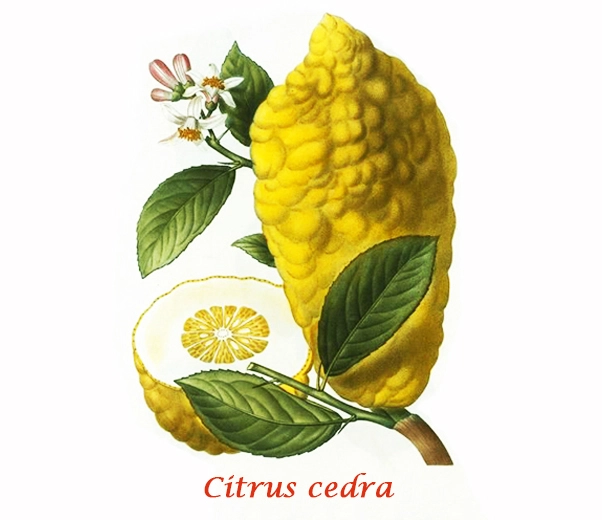
Native to Southeast Asia, the Citron is cultivated primarily in Calabria, the Middle East, India, Indonesia, the USA, and Australia. Also known as "Citro", it is a small tree up to four meters tall, with smooth, oval leaves up to twenty centimeters long and fragrant white flowers.
The fruit of this tree, traditionally associated with nobility, is mostly oval in shape and grows up to thirty centimeters in size with a characteristically thick, wrinkled rind; initially green, it turns yellow as it ripens.
The fruit of this tree, traditionally associated with nobility, is mostly oval in shape and grows up to thirty centimeters in size with a characteristically thick, wrinkled rind; initially green, it turns yellow as it ripens.
Related topics
Related products
 Amyris
 Artemisia
 Bergamot
 Buchu
Buchu Cajeput
 Calamus
 Camphor
 Cardamom
 Carrot seeds
 Clary sage
 Cypress
 Dwarf mountain pine
 English lavender
 Ethiopian olibanum
 Eucalyptus
 Grapefruit
 Incense
 Iris
Iris Juniper berries
 Larch
Larch Lavender in bloom
 Lemongrass
 Marjoram
 Moroccan chamomile
 Neroli
 Niaouli
 Oregano
 Palmarosa
 Patchouli
 Petitgrain Paraguay
 Pink grapefruit
 Rosemary
 Rosewood
 Scots pine
 Sudanese incense
 Talcus citratus
 Valerian
 Vetiver Haiti
 Yarrow
 Ylang-ylang 1°
 Home fragrances
 Aroma chemicals
 Measuring instruments
 Containers
 Fine perfumery fragrances
 Citron
 Fern
Fern