
Cade
Pure and natural essential oil
✔ 100% pure essential oil for industry and laboratory use · Tailored offers
Bulk packaging > Essential oils
A wide range of pure and natural essential oils of guaranteed quality, consistently available for any industrial application.
Highly concentrated natural compounds extracted from various parts of plants such as leaves, inflorescences, twigs, bark, and roots, consisting of the volatile molecules that give different plant species their characteristic aroma.
- Code: T1587
- INCI: Juniperus oxycedrus
- CAS: 8013-10-3
- EINECS: 289-969-0
- Family: Cupressaceae
- Type: pure essential oil (EO)
- Chemotype: α-cedrene (about 39%)
- Food flavoring: No
- Extraction method: steam distillation
- Purity: 100%
- Origin: Spain
Extraction
Cade essential oil is obtained by steam distillation of tar previously produced through the destructive distillation of fruits and twigs. It appears as a brown liquid with a penetrating woody, smoky, and dry aroma that instantly recalls the scent of leather or Birch tar.
Properties
Cade essential oil, completely non-toxic and non-irritating, has antiseptic, antimicrobial, anti-inflammatory, and antipruritic properties. However, it should be used with caution on the skin, as it can occasionally cause sensitization. It is therefore a good idea to always use it with a vegetable oil (such as sweet almond or sesame).
It has long been one of the main natural remedies for treating eczema and dermatitis.
Ancient herbal tradition also considers this essential oil a remedy for dandruff and an excellent treatment for wounds and skin ulcers.
It blends well with the essential oils of birch, cinnamon leaves, clove, mastic, nutmeg, oregano, mountain pine, styrax, tea tree, red thyme, and wintergreen.
It has long been one of the main natural remedies for treating eczema and dermatitis.
Ancient herbal tradition also considers this essential oil a remedy for dandruff and an excellent treatment for wounds and skin ulcers.
It blends well with the essential oils of birch, cinnamon leaves, clove, mastic, nutmeg, oregano, mountain pine, styrax, tea tree, red thyme, and wintergreen.
Uses
Cade essential oil is primarily used in pharmaceuticals as a solvent for active ingredients; more rarely, it is used as a fragrance component in perfumery, cosmetics, and soaps, with woody-spicy and leathery fragrances.
The relevant technical and safety documentation for the product is available upon request.
The relevant technical and safety documentation for the product is available upon request.
Botany
Native to southern France, the Cade is also known as "red juniper" or "thorny cedar".
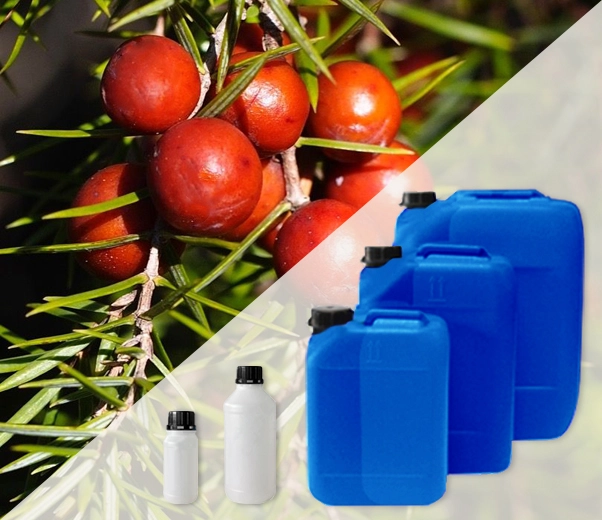
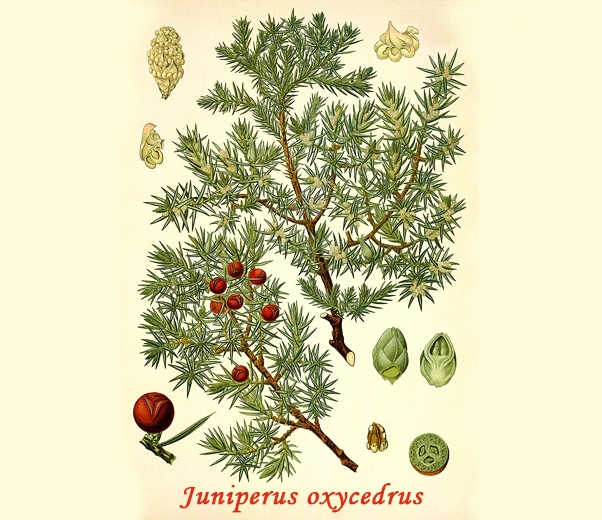
It is an evergreen shrub with grayish bark that can grow to over five meters tall. It has long, dark needles and berries the size of hazelnuts, which, as they ripen, take on a typical reddish-brown color. It is a common species throughout most of Europe and North Africa (Morocco, Algeria, and Tunisia).
Tar extraction is mainly carried out in Spain and the Balkan Peninsula.
It is an evergreen shrub with grayish bark that can grow to over five meters tall. It has long, dark needles and berries the size of hazelnuts, which, as they ripen, take on a typical reddish-brown color. It is a common species throughout most of Europe and North Africa (Morocco, Algeria, and Tunisia).
Tar extraction is mainly carried out in Spain and the Balkan Peninsula.
 Birch
Birch Cinnamon leaves
 Dwarf mountain pine
 Greek mastic
 Liquid storax
 Nutmeg
 Oregano
 Red thyme
 Rue
Rue Tea tree
 Wintergreen
 Home fragrances
 Aroma chemicals
 Measuring instruments
 Containers
 Fine perfumery fragrances
 Cade
Cade