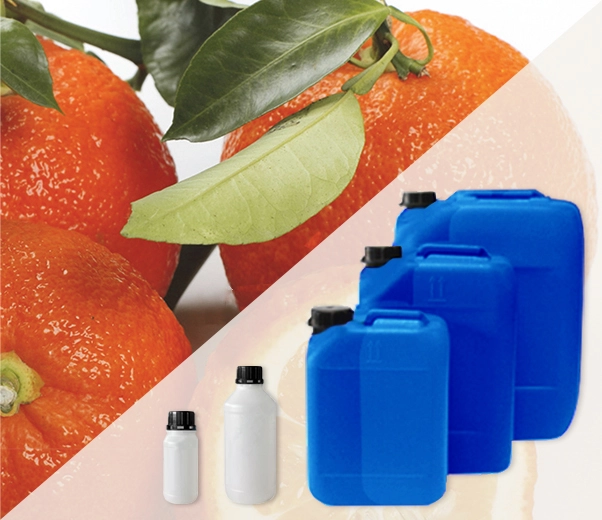

Bitter orange
Pure and natural essential oil
✔ 100% pure essential oil for industry and laboratory use · Tailored offers
Bulk packaging > Essential oils
A wide range of pure and natural essential oils of guaranteed quality, consistently available for any industrial application.
Highly concentrated natural compounds extracted from various parts of plants such as leaves, inflorescences, twigs, bark, and roots, consisting of the volatile molecules that give different plant species their characteristic aroma.
- Code: T1205
- INCI: Citrus aurantium amara
- CAS: 68916-04-1
- EINECS: 277-143-2
- Family: Rutaceae
- Type: pure essential oil (EO)
- Chemotype: δ-limonene (minimum 90%)
- Food flavoring: yes (according to EC Regulation 1334/2008)
- Extraction method: cold pressing
- Purity: 100%
- Origin: Italy (Calabria)
Extraction
Bitter orange essential oil is obtained by cold pressing the fresh peel and appears as a clear, dark yellow liquid with a dry, citrusy scent with a floral undertone.
Properties
Bitter Orange essential oil, completely non-toxic, is a true natural antidepressant that also has anti-inflammatory, antiseptic, astringent, bactericidal, fungicidal, and tonic properties.
It blends well with the essential oils of cinnamon, clove, lavender, lemon, neroli, nutmeg, clary sage, and myrrh absolute.
It blends well with the essential oils of cinnamon, clove, lavender, lemon, neroli, nutmeg, clary sage, and myrrh absolute.
Uses
Also excellent for treating dull and/or oily skin, Sweet Orange essential oil should nevertheless be used in moderation due to its phototoxic nature. It is used in the beverage industry as a flavoring agent, as well as a fragrance component in detergents, cosmetics, and perfumes (particularly men's fragrances). It also serves as the primary raw material for the production of natural limonene.
Relevant technical and safety documentation for the product is available upon request.
Relevant technical and safety documentation for the product is available upon request.
Botany
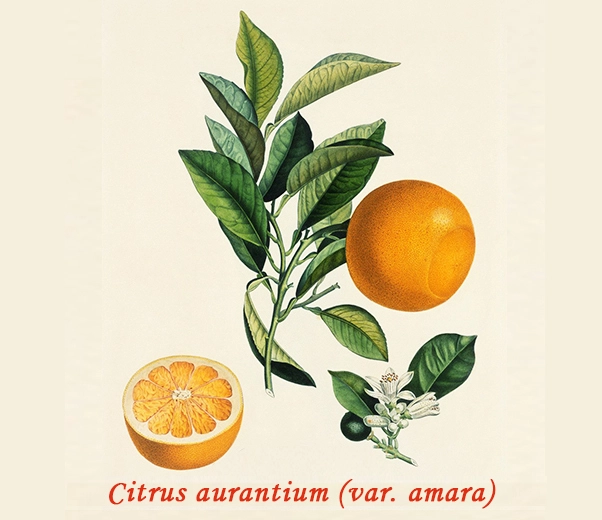
Native to the Far East, the bitter orange tree has adapted well to the climate of the Mediterranean regions, where it is widely cultivated. Also known as "melangolo", it is a small evergreen tree up to ten meters tall with smooth branches, oval, glossy dark green leaves, long thorns, and fragrant white flowers. The fruit is smaller and darker than that of the common sweet orange. Highly disease-resistant, it is widely used for grafting onto other citrus plants.
 Cardamom
 Cinnamon bark
 Cinnamon leaves
 Clary sage
 Clove
Clove Copaiba
 Cypress
 Davana
 English lavender
 Ethiopian olibanum
 Ginger
 Incense
 Italian lemon
 Larch
Larch Lemongrass
 Myrrh
Myrrh Neroli
 Nutmeg
 Rosewood
 Rue
Rue Sudanese incense
 Violet
 Home fragrances
 Aroma chemicals
 Measuring instruments
 Containers
 Fine perfumery fragrances
 Bitter orange