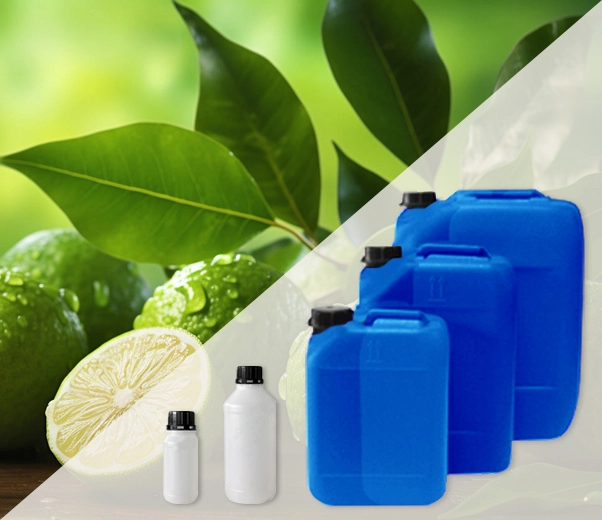

Bergamot
Pure and natural essential oil
✔ 100% pure essential oil for industry and laboratory use · Tailored offers
Bulk packaging > Essential oils
A wide range of pure and natural essential oils of guaranteed quality, consistently available for any industrial application.
Highly concentrated natural compounds extracted from various parts of plants such as leaves, inflorescences, twigs, bark, and roots, consisting of the volatile molecules that give different plant species their characteristic aroma.
- Code: T1206
- INCI: Citrus bergamia
- CAS: 8007-75-8
- EINECS: 289-612-9
- Family: Rutaceae
- Type: pure essential oil (EO)
- Chemotype: Linalyl acetate (minimum 30%)
- Food flavoring: yes (according to EC Regulation 1334/2008)
- Extraction method: cold pressing
- Purity: 100%
- Origin: Italy (Calabria)
Extraction
Bergamot essential oil is obtained by cold pressing the peel of the fruit and is a clear, intense green liquid (which may darken with age) with a sweet, velvety citrus scent, very characteristic.
Properties
Bergamot essential oil, non-toxic, is known in aromatherapy for its refreshing and antidepressant properties, helping to combat anxiety and stress.
It is also effective in treating acne, eczema, insect bites, and cold sores; it is also an effective insect repellent. However, applying this oil to the skin must be done with great caution, as the furocoumarins it contains can be phototoxic following direct exposure to sunlight. Therefore, it is best to dissolve it beforehand in a vegetable oil (olive, almond, or sesame).
It blends perfectly with the essential oils of chamomile, cypress, coriander, geranium, juniper, lemon, neroli, frankincense, and opoponax.
It is also effective in treating acne, eczema, insect bites, and cold sores; it is also an effective insect repellent. However, applying this oil to the skin must be done with great caution, as the furocoumarins it contains can be phototoxic following direct exposure to sunlight. Therefore, it is best to dissolve it beforehand in a vegetable oil (olive, almond, or sesame).
It blends perfectly with the essential oils of chamomile, cypress, coriander, geranium, juniper, lemon, neroli, frankincense, and opoponax.
Uses
Bergamot essential oil is widely used in perfumery and cosmetics, as a fragrance and fixative, as well as in personal care products and suntan lotions. The food industry uses it—among other things—to flavor the famous Earl Grey tea.
The relevant technical and safety documentation for the product is available upon request.
The relevant technical and safety documentation for the product is available upon request.
Botany
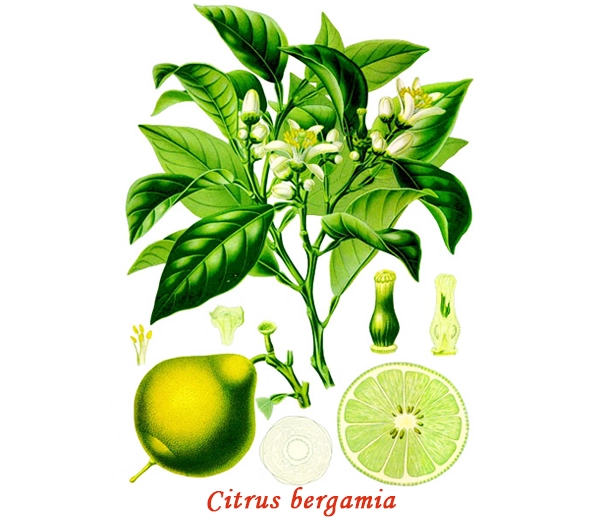
Originally from tropical Asia, the bergamot is now grown mainly in Calabria and the Ivory Coast.
It grows into a small tree about four meters tall with smooth, oval leaves and round, green fruits that turn yellow as they ripen.
Its name comes from the Italian city of Bergamo, where the oil pressed from the fruit's peel was first commercially available.
It grows into a small tree about four meters tall with smooth, oval leaves and round, green fruits that turn yellow as they ripen.
Its name comes from the Italian city of Bergamo, where the oil pressed from the fruit's peel was first commercially available.
Related topics
Related products
 Acacia flower
 African geranium
 Basil
Basil Bulgarian rose
 Cardamom
 Cistus
 Citron
 Clary sage
 Clove
Clove Copaiba
 Coriander
 Cypress
 Davana
 Ethiopian olibanum
 Grapefruit
 Incense
 Iris
Iris Italian lemon
 Juniper berries
 Larch
Larch Lemongrass
 Marigold
 Marjoram
 Matricaria chamomile
 Moroccan chamomile
 Myrtle
 Neroli
 Opoponax
 Patchouli
 Pink grapefruit
 Red thyme
 Roman chamomile
 Sudanese incense
 Talcus citratus
 Tonka bean
 Turkish rose
 Turkish rose
 Ylang-ylang 1°
 Home fragrances
 Aroma chemicals
 Measuring instruments
 Containers
 Fine perfumery fragrances
 Bergamot
 Kayuragi ginger