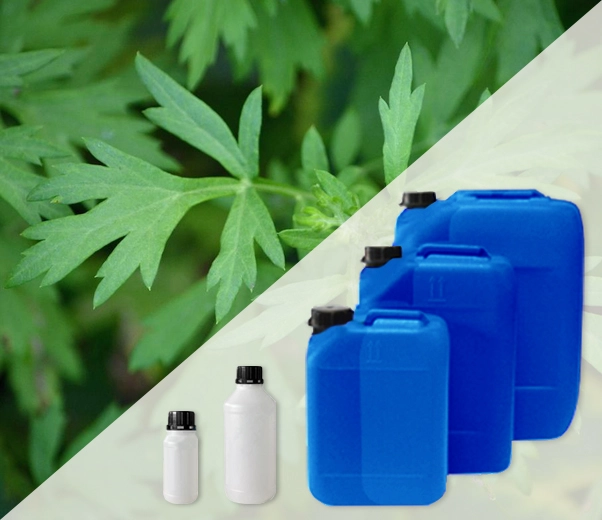

Artemisia
Pure and natural essential oil
✔ 100% pure essential oil for industry and laboratory use · Tailored offers
Bulk packaging > Essential oils
A wide range of pure and natural essential oils of guaranteed quality, consistently available for any industrial application.
Highly concentrated natural compounds extracted from various parts of plants such as leaves, inflorescences, twigs, bark, and roots, consisting of the volatile molecules that give different plant species their characteristic aroma.
- Code: T1504
- INCI: Artemisia vulgaris
- CAS: 68991-20-8
- EINECS: 283-874-8
- Family: Asteraceae
- Type: pure essential oil (EO)
- Chemotype: α‑thujone (minimum 45%)
- Food flavoring: yes (according to EC Regulation 1334/2008)
- Extraction method: steam distillation
- Purity: 100%
- Origin: Nepal
Extraction
Artemisia essential oil is obtained by steam distillation of the leaves and flowering tops. It is a nearly colorless liquid with a powerful, camphorous, bittersweet, herbaceous odor.
Properties
Due to its thujone content, Artemisia essential oil is toxic and therefore lacks any effective aromatherapeutic properties. Used in extreme moderation, it is nevertheless an effective remedy for treating chapped skin, scabies, and sores.
It blends well with the essential oils of Cedar, Lavender, Patchouli, Pine, Ravensara, Rosemary, Sage, and Oakmoss absolute.
It blends well with the essential oils of Cedar, Lavender, Patchouli, Pine, Ravensara, Rosemary, Sage, and Oakmoss absolute.
Uses
Artemisia essential oil is traditionally used in perfumery (colognes) and soap making, as a fragrance component.
The relevant technical and safety documentation for the product is available upon request.
The relevant technical and safety documentation for the product is available upon request.
Botany
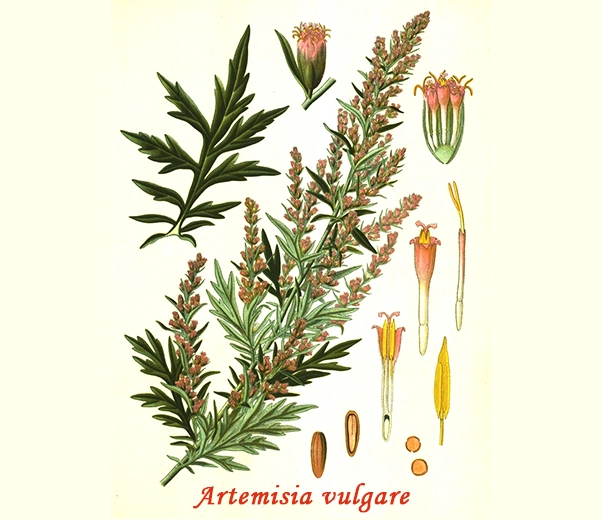
Also known as "wild wormwood", Artemisia grows wild in nearly every temperate zone of the world.
It is a perennial herbaceous plant, up to one and a half meters tall, with many branches. It has dark green lanceolate leaves covered with a whitish down on the underside, and brownish, red, or yellow flowers. There are numerous species of Artemisia.
It is a perennial herbaceous plant, up to one and a half meters tall, with many branches. It has dark green lanceolate leaves covered with a whitish down on the underside, and brownish, red, or yellow flowers. There are numerous species of Artemisia.
 Citron
 Clary sage
 Dwarf mountain pine
 English lavender
 Magnolia flower
 Moroccan chamomile
 Oakmoss
 Patchouli
 Ravensara
 Rosemary
 Scots pine
 Siberian pine
 Swiss pine
 Home fragrances
 Aroma chemicals
 Measuring instruments
 Containers
 Fine perfumery fragrances
 Artemisia
 Woodland flowers