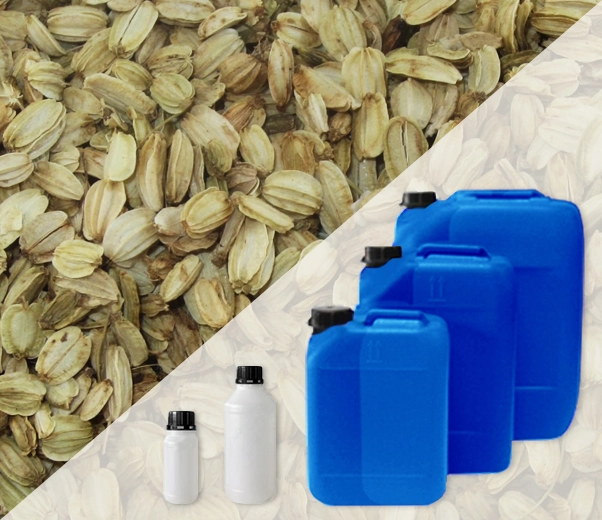

Angelica seeds
Pure and natural essential oil
✔ 100% pure essential oil for industry and laboratory use · Tailored offers
Bulk packaging > Essential oils
A wide range of pure and natural essential oils of guaranteed quality, consistently available for any industrial application.
Highly concentrated natural compounds extracted from various parts of plants such as leaves, inflorescences, twigs, bark, and roots, consisting of the volatile molecules that give different plant species their characteristic aroma.
- Code: T1511
- INCI: Angelica archangelica
- CAS: 8015-64-3
- EINECS: 283-871-1
- Family: Apiaceae
- Type: pure essential oil (EO)
- Chemotype: β‑phellandrene (minimum 66%)
- Food flavoring: yes (according to EC Regulation 1334/2008)
- Extraction method: steam distillation
- Purity: 100%
- Origin: Belgium
Extraction
Angelica essential oil is extracted by steam distilling the plant's seeds (the yield is very small). It appears as a clear, colorless liquid that releases a characteristic, fresh, herbaceous-spicy scent.
Properties
Angelica seed essential oil, non-toxic and non-irritating, is mildly antiseptic and fungicidal, and has expectorant, bittering, and tonic properties. Effective against dull skin, it is also a remedy for psoriasis.
It blends well with lavender, patchouli, black pepper, clary sage, and vetiver essential oils, as well as oakmoss absolute and citrus oils.
It blends well with lavender, patchouli, black pepper, clary sage, and vetiver essential oils, as well as oakmoss absolute and citrus oils.
Uses
Highly prized as a fragrance component in perfumery (oriental fragrances), the essential oil extracted from Angelica seeds is present in the formulas of various cosmetics (especially lotions) due to its soothing effect on the skin. It is also used as a flavoring in various food products, in liqueurs, and in soaps.
The relevant technical and safety documentation for the product is available upon request.
The relevant technical and safety documentation for the product is available upon request.
Botany
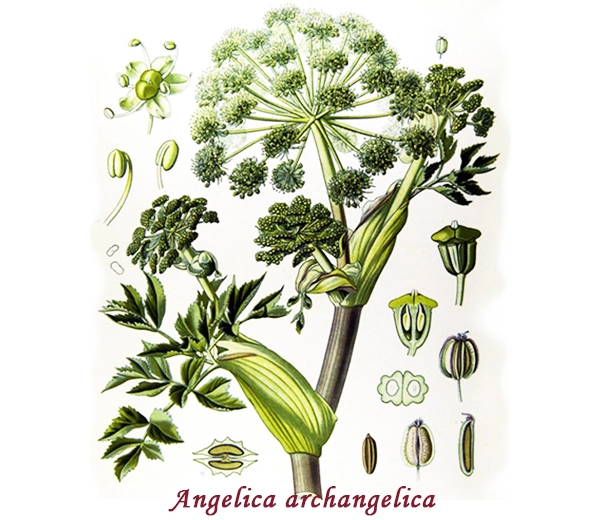
Also known as "Angel's Herb", Angelica is native to northern Eurasia. It is a large, aromatic shrub growing up to one and a half meters tall, with broad, laciniated leaves and white flowers clustered in umbels that bloom in late summer. Its appearance resembles that of fennel
(to which it is related); it grows mostly near watercourses. It is cultivated primarily in Hungary, Germany, and Belgium.
(to which it is related); it grows mostly near watercourses. It is cultivated primarily in Hungary, Germany, and Belgium.
 Black pepper
 Clary sage
 English lavender
 Hemp
Hemp Oakmoss
 Patchouli
 Vetiver Haiti
 Home fragrances
 Aroma chemicals
 Measuring instruments
 Containers
 Fine perfumery fragrances
 Angelica seeds
 Anatolian silk
 Tea lights in envelopes