
Myrrh
Absolute essence
✔ Absolute oil guaranteed for industry and laboratory use · Tailored quotations
Bulk packaging > Absolute oils
Absolute essences are aromatic extracts obtained through solvent extraction from plant material or from the concrete. They differ from essential oils in that they contain less volatile and heavier fractions, which impart greater olfactory richness and persistence. They are mainly produced when steam distillation is not feasible or does not ensure the desired yield, as in the case of rose. Owing to their concentration and complexity, they are key raw materials in fine perfumery, cosmetics, soap making, and candle production.
- Code: T1561
- INCI: Commiphora myrrha
- CAS: 8016-37-3
- EINECS: 284-510-0
- Family: Burseraceae
- Type: absolute essence (OA)
- Chemotype: δ-elemene (about 22%)
- Food flavoring: yes (according to EC Regulation 1334/2008)
- Extraction method: with solvent
- Origin: Somalia
Extraction
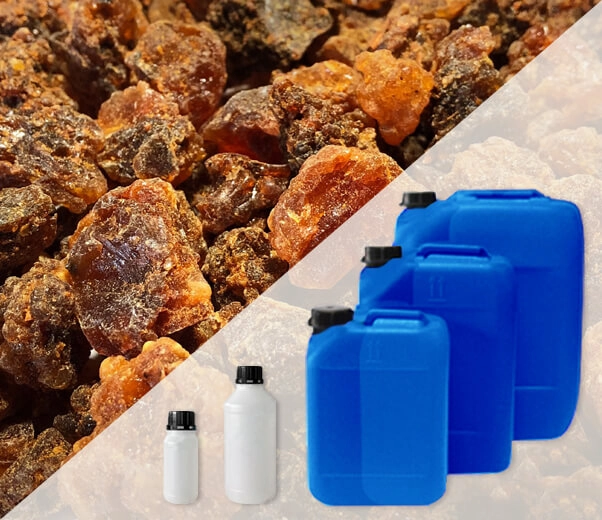
Myrrh absolute is obtained through solvent extraction of the resin. It appears as a dark red liquid with a characteristic, warm, spicy-balsamic aroma with a medicinal undertone, and is very persistent.
Properties
Myrrh absolute oil, completely non-toxic and non-irritating, has antiseptic, balsamic, stimulating, and tonic properties; it is an excellent remedy for chapped skin, itching, and the development of wrinkles.
It harmonizes well with benzoin and oakmoss absolutes, with spicy oils, and with the essential oils of cypress, geranium, juniper, frankincense, olibanum, lavender, mandarin, mint, opoponax, patchouli, sandalwood, and red thyme.
It harmonizes well with benzoin and oakmoss absolutes, with spicy oils, and with the essential oils of cypress, geranium, juniper, frankincense, olibanum, lavender, mandarin, mint, opoponax, patchouli, sandalwood, and red thyme.
Uses
Used as a fixative and fragrance component in perfumery and cosmetics, myrrh absolute is also used as a flavoring ingredient for beverages and foods.
The relevant technical and safety documentation for the product is available upon request.
The relevant technical and safety documentation for the product is available upon request.
Botany
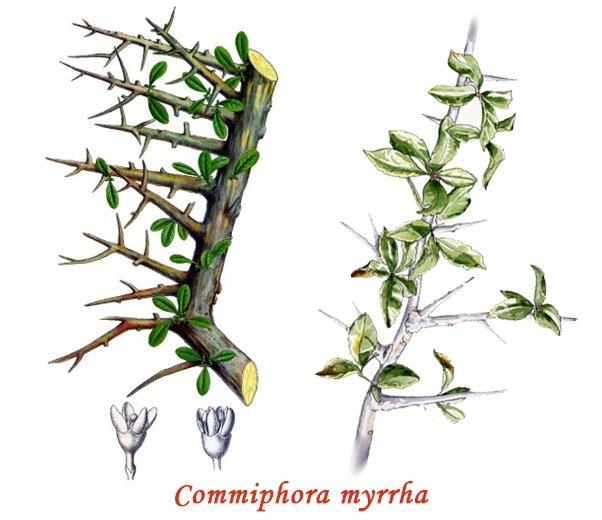
Native to East Africa and the Arabian Peninsula, myrrh is a shrub that grows up to ten meters tall, with sturdy, gnarled branches, aromatic leaves, and small white flowers. The trunk exudes a natural oleoresin which, when solidified, takes on the appearance of reddish-brown tears known as "myrrh gum". To increase yield, harvesters make incisions in the tree's bark.
Related topics
Related products
 African geranium
 Apple mint
 Balsam of Peru
 Benzoin
 Bitter orange
 Cypress
 Elemi
Elemi English lavender
 Eritrean oil
 Ethiopian olibanum
 Field mint
 Galangal
 Green tangerine
 Juniper berries
 Levant Galbanum
 Liquid storax
 Myrrh
Myrrh Mysore sandalwood
 Oakmoss
 Opoponax
 Palo Santo fruit
 Patchouli
 Peppermint
 Red thyme
 Sudanese incense
 Sweet orange
 Home fragrances
 Aroma chemicals
 Measuring instruments
 Containers
 Fine perfumery fragrances
 Myrrh
Myrrh