Benzoin
Absolute essence
✔ Absolute oil guaranteed for industry and laboratory use · Tailored quotations
Bulk packaging > Absolute oils
Absolute essences are aromatic extracts obtained through solvent extraction from plant material or from the concrete. They differ from essential oils in that they contain less volatile and heavier fractions, which impart greater olfactory richness and persistence. They are mainly produced when steam distillation is not feasible or does not ensure the desired yield, as in the case of rose. Owing to their concentration and complexity, they are key raw materials in fine perfumery, cosmetics, soap making, and candle production.
- Code: T1506
- INCI: Styrax benzoin
- CAS: 84929-79-3
- EINECS: 284-557-7
- Family: Styracaceae
- Type: absolute essence (OA)
- Chemotype: Benzyl benzoate (approximately 65%)
- Food flavoring: yes (according to EC Regulation 1334/2008)
- Extraction method: solvent treatment
- Origin: Sumatra
Extraction
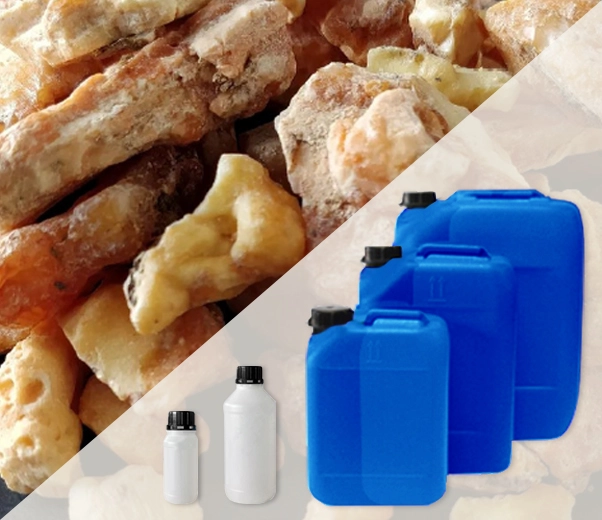
Benzoin absolute is obtained by treating the resin with solvents, which are then removed from the solution. It appears as a brown-orange liquid with an intense sweet-vanilla scent.
Properties
A prized aromatic raw material, Benzoin absolute has been known for centuries for its anti-inflammatory, deodorant, and preservative properties.
It blends well with a wide range of oils, particularly Myrrh absolute and the essential oils of Agarwood, Copaiba, Nutmeg, Opoponax, Frankincense, Black Pepper, Sandalwood, and Vetiver.
It blends well with a wide range of oils, particularly Myrrh absolute and the essential oils of Agarwood, Copaiba, Nutmeg, Opoponax, Frankincense, Black Pepper, Sandalwood, and Vetiver.
Uses
Today, Benzoin is used both as a component and as a fixative in fragrances that deodorize soaps, cosmetics, pharmaceuticals, and perfumes.
In fine perfumery, its alcoholic tincture and absolute essence remain indispensable fixatives. Finally, it is also used in the alcoholic and non-alcoholic beverage industry as a flavoring ingredient.
The relevant technical and safety documentation for the product is available upon request.
In fine perfumery, its alcoholic tincture and absolute essence remain indispensable fixatives. Finally, it is also used in the alcoholic and non-alcoholic beverage industry as a flavoring ingredient.
The relevant technical and safety documentation for the product is available upon request.
Botany
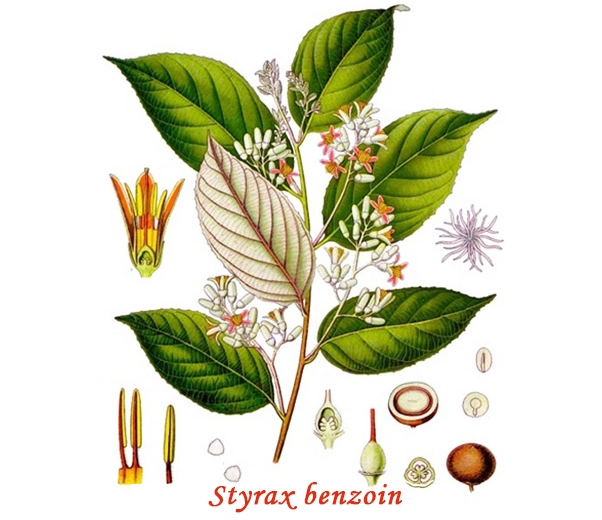
Native to tropical Asia (Laos, Vietnam, and Cambodia), Benzoin grows into a large tree, up to twenty meters tall, with light green leaves similar to those of citrus fruits. Deep incisions in the stem allow the plant to exude a pathological resin; this secretion hardens upon contact with air and exposure to sunlight, forming solid masses with a characteristic orange-yellow color known as "benzoin gum" or "Java incense."
Related topics
Related products
 Agarwood
 Apple mint
 Black pepper
 Bulgarian rose
 Cedar wood
 Cinnamon bark
 Cinnamon leaves
 Copaiba
 Cypress
 Ethiopian olibanum
 Field mint
 Italian lemon
 Juniper berries
 Lemon zest
 Matricaria chamomile
 Myrrh
Myrrh Myrrh
Myrrh Mysore sandalwood
 Neroli
 Nutmeg
 Oakmoss
 Opoponax
 Orange blossom
 Patchouli
 Peppermint
 Sandalwood
 Turkish rose
 Turkish rose
 Vanilla
 Vetiver Haiti
 Home fragrances
 Aroma chemicals
 Measuring instruments
 Containers
 Fine perfumery fragrances
 Benzoin