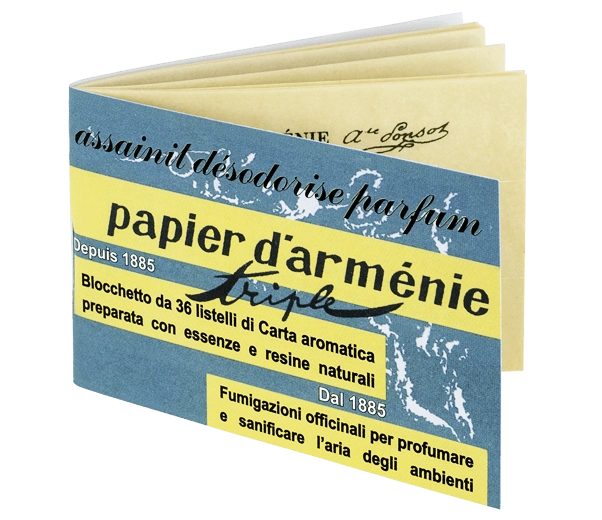
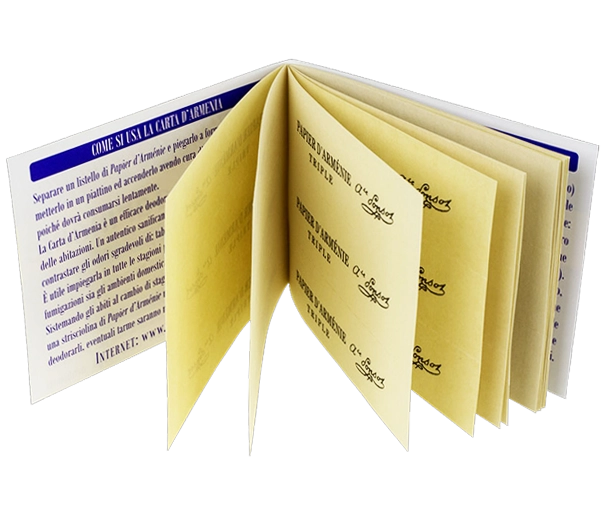
Classic Armenian paper
A classic of the French "Belle Époque".
Packaging: paper pad of 36 strips
-
5,88 €
Aromatic healing papers
In the early days of modern industrial society, aromatic officinal papers— formerly known as "medicinal papers" —represented a genuine medicinal remedy for various ailments in Europe, as well as the only product on the market capable of both deodorizing and sanitizing environments. Tents, hospitals, colleges, and damp homes, for example, were all places at risk of epidemics: for this reason, they were routinely purified with fumigations diffused by the flameless combustion of these papers, which nevertheless released a pleasant scent.
- Code: 00661
- Note type: vanilla-like, resinous, balsamic
- Origin: France
Description
When burned, Armenian Paper ("Papier d'Arménie", the oldest air freshener on the market) releases a persistent and pleasant sweet-balsamic aroma, given off by its basic ingredient: natural benzoin oleoresin, which also possesses strong antiseptic properties due to its high benzoic acid content (approximately 25%). Armenian Paper is a truly eco-friendly product, as the special absorbent sheets used in its manufacture are certified by the Forest Steward Council, an independent international organization that operates globally to promote responsible management of forest resources. Present on the market since 1885, the famous Armenian Paper remains one of the very few "survivors" (and certainly the oldest among them) of the so-called medicinal papers, those sanitizing deodorants that were widespread between the 17th and early 20th centuries, which came in the form of paper that was burned without a flame. The most refined enthusiasts of “officinal fumigations” have always mentioned this appreciated French product from times gone by.
History
The history of Armenian Paper began in the late 19th century, when Frenchman Auguste Ponsot, traveling through the Ottoman Empire, visited Armenia (a country then part of that empire). He was amazed to discover that the inhabitants perfumed and purified their homes by burning a natural resin with a balsamic-vanilla scent: benzoin. Upon returning to France, Ponsot decided to spread this traditional practice throughout Europe. His success was aided by the insight of his pharmacist partner Henri Rivier, who dissolved the oleoresin in alcohol to produce a benzoin tincture, which he then soaked into a suitably treated cellulose substrate. Armenian Paper was therefore produced according to the common procedures for manufacturing any medicinal paper, but with a new ingredient: benzoin oleoresin (also called benzoin gum), thus allowing Europeans to benefit from the benefits of this natural raw material (until then used exclusively by perfumers as a valuable fixative).
The production of medicinal papers was entirely artisanal and the almost exclusive prerogative of specialized pharmacists, who had special formulations for preparing various fumigant papers: anti-asthmatic, anti-rheumatic, antiseptic, etc., as specific medical/therapeutic treatments for various health problems.
Of the various medicinal papers on sale in the kingdoms of Europe between the 16th and the mid-20th century, probably only two remain on the market today, almost certainly the last in their history, both of the deodorant/antiseptic genre, very popular and with a long tradition behind them: the Italian " Carta d'Eritrea " and the French " Papier d'Arménie ".
The production of medicinal papers was entirely artisanal and the almost exclusive prerogative of specialized pharmacists, who had special formulations for preparing various fumigant papers: anti-asthmatic, anti-rheumatic, antiseptic, etc., as specific medical/therapeutic treatments for various health problems.
Of the various medicinal papers on sale in the kingdoms of Europe between the 16th and the mid-20th century, probably only two remain on the market today, almost certainly the last in their history, both of the deodorant/antiseptic genre, very popular and with a long tradition behind them: the Italian " Carta d'Eritrea " and the French " Papier d'Arménie ".
 aromatic eritrean paper
 Benzoin
 Blue Eritrean paper
 Classic armenian paper
 Rose Armenian paper
 White Armenian paper
 Japanese incense
 Wooden scenters
 Tibetan rituals
 Resins and balms
 Classic Armenian paper
 African geranium
 Artemisia
 Woodland flowers